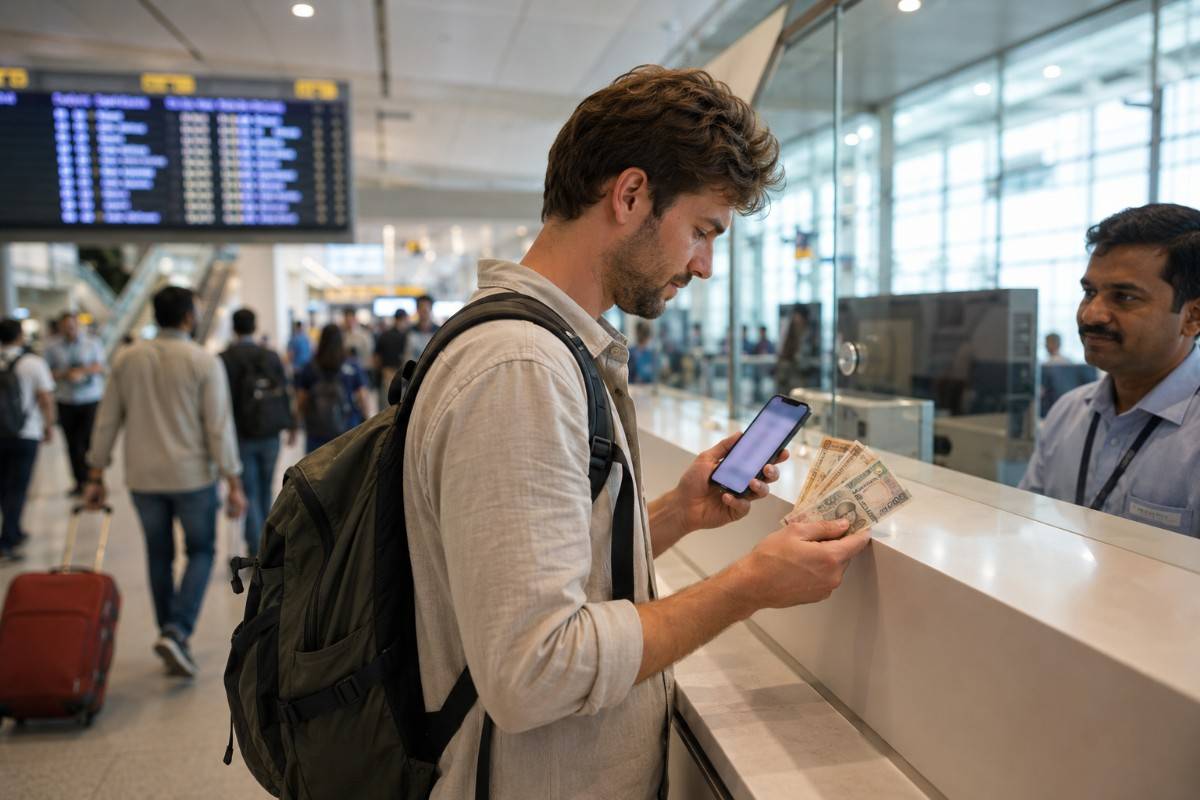
The currency exchange counter at the airport looks official, convenient, and trustworthy. It is also the most expensive financial decision most tourists make before spending a single rupee on something they actually want.
Airport money changers in India charge 8% to 9% above the real rate, hidden inside the exchange rate itself. What they charge, where the better options are, and how to arrive in India spending less before you even leave the terminal.
Key highlights
- Airport currency exchange counters in India typically offer rates 8% to 9% worse than the mid-market interbank rate, per multiple consumer comparisons and RBI data.
- On a USD 300 exchange at an 8% to 9% markup, a tourist loses approximately Rs 2,500 (approx $26.21) compared to the real rate.
- City ATMs from major Indian banks like SBI, HDFC, and ICICI offer significantly better rates than airport counters, though withdrawal fees still apply.
- RBI-authorized money changers in city centers typically charge 1% to 3% above the interbank rate, far below airport counter margins.
- Most tourist spending in India is now UPI-first. Street food, transport, restaurants, and markets all accept QR-code payments.
- CheqUPI is free to join for all eligible nationalities. The wallet loading fee is 2.95% + applicable taxes for all foreign users. There are no transaction fees when paying merchants through UPI.
Why do airport money changers in India charge so much?
Airport money changers are not offering a bad deal by accident. The pricing is structural, and understanding why helps you stop feeling surprised by it.
High rent, captive audience, low competition
Counter space at major Indian airports like IGI Delhi, Chhatrapati Shivaji Mumbai, and Kempegowda Bengaluru costs significantly more than commercial city real estate. Operators pay premium rents to airport authorities, and those costs pass directly to customers through wider exchange margins. Airports also limit the number of licensed exchange operators at each terminal, which reduces competitive pressure on rates. A tourist who has just landed and needs rupees for a taxi has no real alternative at that moment. Airport money changers know this and price accordingly.
How is the markup hidden from you?
The fee at an airport money changer is almost never displayed as a percentage. Instead, the counter offers you a rate, say Rs 78 per dollar, when the real mid-market rate is Rs 84. That six-rupee difference is the fee. On the surface, it looks like an exchange rate, not a charge. Many counters also advertise zero commission, which is technically accurate because the margin is built into the rate itself, not applied as a separate line item. Always compare the offered rate against the mid-market rate on Google or XE before accepting any exchange.
What does airport currency exchange actually cost in India
The markup is only one part of the total cost. Multiple charges are layered on top of each other at airport counters.
The markup on the rate
Airport counters in India typically price 8% to 9% below the interbank rate on major currencies like USD, EUR, and GBP. At peak travel times or for less common currencies, that margin can reach 10% to 15%. On a USD 300 exchange at an 8% to 9% markup, you receive roughly Rs 2,300 (approx $24.11) less than the interbank rate would give you. That is money spent on nothing except convenience.
Service fees and GST on top
Beyond the rate markup, many airport counters charge a flat service fee per transaction of Rs 100 to Rs 300 (approx $1 to $3). GST applies to all foreign exchange transactions in India under a slab system set by the government. On amounts up to Rs 100,000, GST is 0.18% of the transaction amount, with a minimum of Rs 45. On amounts between Rs 100,000 and Rs 1,000,000, the GST is Rs 180 plus 0.09% of the amount above Rs 100,000. These charges are applied on top of an already unfavorable rate.
Better places to exchange money in India
If you need Indian rupees in cash, several alternatives beat the airport counter significantly.
City ATMs from major banks
ATMs operated by SBI, HDFC, ICICI, and Axis Bank inside or directly outside their branch offices give you the Visa or Mastercard network rate, which is typically 1% to 2% above the interbank rate. Your home bank may add a fixed withdrawal fee of Rs 200 to Rs 500 (approx $2 to $5) per transaction and a foreign transaction fee of 1% to 3%. The combined cost is still significantly lower than at an airport counter for most withdrawals above Rs 5,000 (approx $53). Withdraw larger amounts per visit rather than making multiple small withdrawals to minimize the fixed fee impact.
Always choose to pay in Indian Rupees when an ATM offers you a choice between INR and your home currency. Dynamic Currency Conversion, where the machine processes the transaction in your home currency, gives you an even worse rate than your bank’s standard conversion, and the difference goes to the ATM operator.
RBI-authorised money changers in city centres
Licensed authorized money changers operating in commercial areas of Delhi, Mumbai, Bengaluru, Kochi, and other major cities typically offer rates 1% to 3% above the interbank rate. That is a significant improvement over airport counters. You can verify whether a money changer holds a valid RBI license on the Reserve Bank of India website before exchanging any money. Never exchange currency with unlicensed street operators or individual touts, regardless of the rate they offer.
Your hotel and why it is still not the best option
Most mid-range and luxury hotels in India offer currency exchange at the front desk. Hotel rates are usually better than airport counters but still carry a margin of 3% to 5% above the interbank rate. Use the hotel counter only if a city ATM or authorized money changer is not accessible during your stay. For safety tips on handling cash and managing money while traveling in India.
How much cash do you actually need in India?

This is the question most currency guides avoid because the honest answer reduces how much money tourists exchange. Most tourist spending in India does not require cash at all.
Where cash is still essential
Cash remains necessary in specific situations. Remote rural areas, small village vendors, roadside stalls without QR codes, auto-rickshaw drivers in some smaller towns, and temple donation boxes are still cash-only. Houseboat crew tips in Kerala, boat operators in Varanasi, and some national park entry counters also require physical rupees. A reserve of Rs 5,000 to Rs 10,000 in small denominations covers these situations for most trips.
Where UPI covers everything
The majority of daily tourist spending in India is UPI-first. Street food stalls, local restaurants, markets, pharmacies, auto-rickshaws in cities, museum entry tickets, guesthouses, and taxi apps all accept QR-code payments. India processed over 21 billion UPI transactions in January 2026 alone. For a foreign tourist who has set up a UPI wallet before landing, the need for physical rupees drops dramatically. For a complete guide on how UPI works for foreign tourists, see our complete UPI guide.
How CheqUPI reduces your need for airport money changers
The most effective way to avoid airport money changer fees is to need less cash. CheqUPI makes that practical.
What CheqUPI is and how it works
CheqUPI is an RBI-licensed prepaid payment instrument built for foreign tourists and NRIs. You load it using your international credit or debit card, receive a UPI ID, and scan any merchant QR code in India to pay instantly. No Indian bank account is needed. No currency exchange counter is involved. The wallet is built on Transcorp International’s PPI and Authorized Dealer Category II license, backed by Y Combinator (W22). It is free to join for all eligible nationalities. The loading fee is 2.95% + applicable taxes for all foreign users.
What it costs vs. airport exchange
CheqUPI charges a loading fee of 2.95% + applicable taxes for all foreign users, plus tax per top-up. On top-ups below Rs 10,000, an additional Rs 150 applies. On a Rs 20,000 load, the total fee is approximately Rs 700, including tax. Every merchant payment after that costs zero. Compare that to exchanging the equivalent amount at an airport counter at an 8% markup, which costs roughly Rs 1,800 on the same Rs 20,000 in value. The UPI wallet loading fee is less than half the airport counter cost, and it covers 55 million merchants with zero per-transaction charges for the rest of your trip.
Practical tips before you land in India

Exchange only a small amount at the airport. Rs 3,000 to Rs 5,000 (approx $31.45 to $52.42) covers a taxi and a SIM card. That is all you need from the airport counter. Get everything else from a city ATM or via UPI.
Set up CheqUPI before your flight. The app is available on Android and iOS and completes your registration by verifying your mobile number and uploading your passport details. Once you arrive in India, complete the mandatory in-person verification to activate your wallet, add funds, and start paying with UPI.
Use bank-branch ATMs, not standalone ATMs in shops or convenience stores. Branch ATMs from SBI, HDFC, ICICI, and Axis are more reliable and less likely to add excessive operator surcharges.
Always choose INR at ATMs and payment terminals. Never accept Dynamic Currency Conversion. The rate offered in your home currency is always worse than your bank’s standard conversion rate.
Keep Rs 5,000 to Rs 10,000 in small notes throughout your trip for situations where no QR code exists. Replenish from a city ATM rather than an airport counter every time.
Conclusion
Airport money changers in India are expensive by design, not by accident. The combination of high rents, limited competition, and a captive audience of just-landed tourists produces margins of 8% to 9% that no informed traveler should pay for more than the minimum amount needed to get out of the airport. Set up a UPI wallet before you fly, withdraw cash from city ATMs when you genuinely need it, and limit your airport counter exposure to the bare minimum for immediate transport and SIM costs. That approach cuts your currency exchange costs significantly before your trip even begins.
FAQs
How much do airport money changers charge in India?
Airport currency exchange counters in India typically charge 8% to 9% above the mid-market interbank rate, plus service fees and GST. They are consistently the most expensive option available.
What is the best place to exchange money in India as a tourist?
RBI-authorized money changers in city centers offer rates 1% to 3% above interbank. City ATMs from major banks like SBI and HDFC are also significantly better than airport counters.
Should I exchange money at the airport when arriving in India?
Exchange only a small amount, Rs 3,000 to Rs 5,000, for immediate needs like a taxi and a SIM card. Get the rest from a city ATM or load a UPI wallet like CheqUPI instead.
How much cash should I carry in India as a tourist?
Rs 5,000 to Rs 10,000 in small notes is enough for most trips as a backup reserve. Most daily spending in India is now covered by UPI QR payments.
What are the airport forex rates in India in 2026?
Airport counters typically offer 8% to 9% below the interbank rate, depending on currency and time of day. Peak travel season and less common currencies attract wider margins.
Is it better to exchange money before or after arriving in India?
Neither, if you can avoid it. Load a UPI wallet via your international card and use city ATMs for cash. Both options are cheaper than pre-trip or airport exchanges.
Can tourists use UPI in India without exchanging cash?
Yes. RBI-licensed UPI wallets like CheqUPI let foreign tourists load funds via international card and pay at 55 million+ merchants by scanning a QR code. No cash exchange needed for most spending.
What is a good exchange rate in India for tourists?
A rate within 1% to 2% of the mid-market rate is competitive. Check the current mid-market rate on Google or XE before any exchange and compare it to the offered rate.
How do I find an RBI-authorized money changer in India?
You can verify any money changer’s RBI license on the Reserve Bank of India website. Look for Full-Fledged Money Changers (FFMCs) in commercial areas of major cities rather than tourist zones.
What is Dynamic Currency Conversion, and should I avoid it?
Dynamic Currency Conversion is when an ATM or terminal processes your transaction in your home currency instead of INR. Always choose INR. The DCC rate is worse than your bank’s standard conversion, and the difference goes to the terminal operator.
“The airport counter takes your money before your trip even begins. Download CheqUPI. Activate your wallet after arriving in India and start paying with UPI in minutes.”