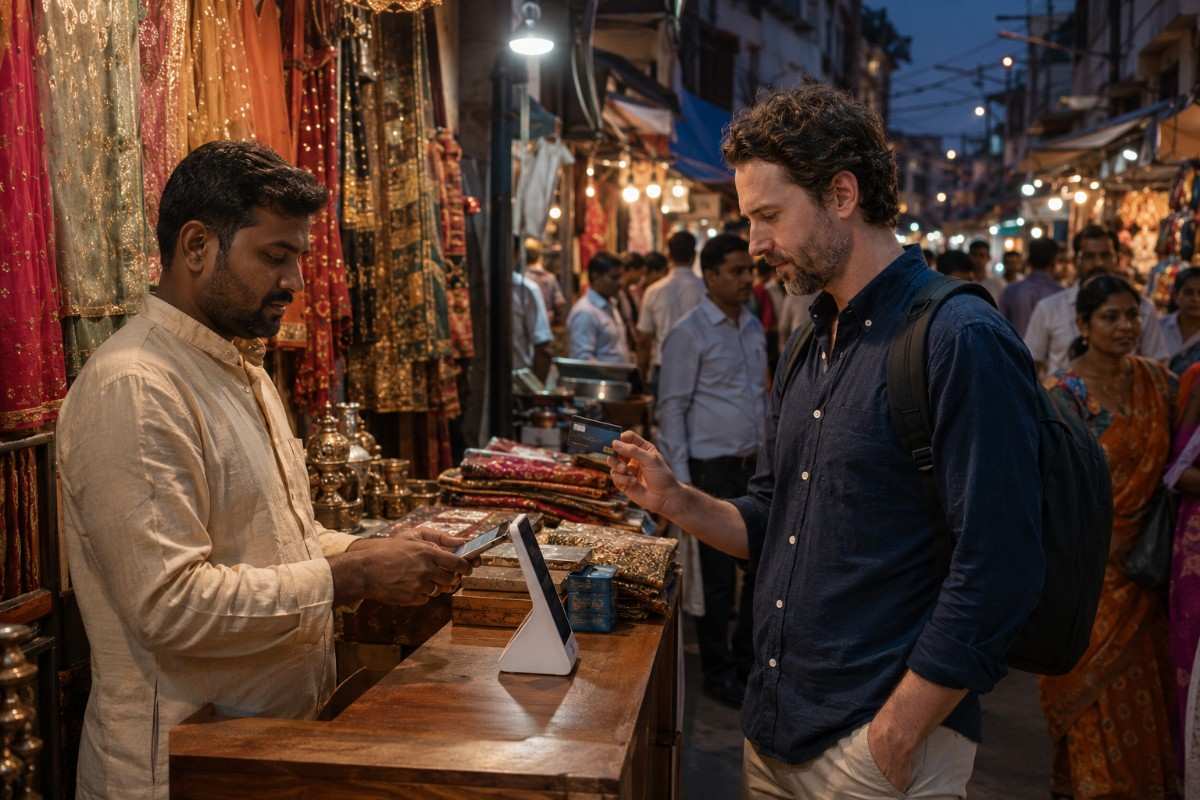
Walk into a restaurant in India, and the waiter points to a QR code on the table. You open your banking app, hold your phone up, and nothing happens. You try Google Pay and it asks for an Indian bank account. You tap your Visa card, and the merchant shakes his head. This is not a glitch. It happens to almost every foreign visitor on their first day, and it keeps happening until they understand why.
India built its payment system on a domestic rail called UPI, and Visa and Mastercard were never connected to it. For foreign tourists without an Indian bank account, standard payment apps do not work at all. The fix takes about an hour and can be done before you land. Below is why your card fails, what it costs tourists who fall back on ATMs and money changers, and the one route that puts your international card onto India’s UPI network.
Key Highlights
- UPI accounts for over 75% of India’s retail digital payments by volume as of 2026
- Since 2022, only RuPay credit cards can process transactions through UPI. Visa and Mastercard are excluded by policy
- India has 230 million UPI QR codes, but only 7.3 million card swipe terminals
- Your foreign card has no technical path into the UPI system without a prepaid wallet
- CheqUPI is a UPI-enabled PPI wallet issued in partnership with RBI-licensed Transcorp International Limited that loads your international card onto the UPI network
- There is no joining fee for most nationalities. The loading fee is 2.95%. Merchant payments cost Rs 0
How UPI Actually Works
UPI is a real-time payment system built by the National Payments Corporation of India (NPCI) that connects bank accounts directly. When you scan a QR code in India, the payment moves instantly from one bank account to another with no card network involved.
This is fundamentally different from how Visa and Mastercard work. They route transactions through a card-based system with multiple intermediaries. UPI routes nothing through them. It goes bank to bank on a domestic rail that Visa and Mastercard simply do not sit on.
Why It Bypasses Visa and Mastercard Entirely
Visa and Mastercard operate on a card-based model where a unique card number identifies the user and transaction details are routed through their networks for authorisation and settlement. UPI skips all of that. It uses a Virtual Payment Address linked to a bank account, not a card number. There is no step in the UPI process where a Visa or Mastercard network is needed.
When a merchant shows you a UPI QR code, your Visa card has no path in. The code is designed for bank-to-bank transfers on a domestic system, your card does not touch.
The RuPay Exclusivity Rule

In 2022, the Indian government gave RuPay exclusive rights to process credit card transactions through UPI. RuPay is India’s domestic card network, run by the National Payments Corporation of India (NPCI). This policy decision locked Visa and Mastercard out of UPI credit card transactions entirely.
Even Indian residents with Visa or Mastercard credit cards cannot use them on UPI. For foreign tourists, the exclusion runs even deeper, because you do not hold any Indian bank account at all.
What Happens When You Try Anyway
Most tourists try three workarounds before giving up and finding an ATM. All three fail for different reasons.
Scenario 1: Scanning the QR Code With Your Home Banking App
Your home bank’s app is not on the UPI rail. The QR code at an Indian merchant encodes a UPI ID, which is a Virtual Payment Address linked to an Indian bank account. Your banking app cannot read or route to that. The scan either fails entirely or returns an error.
Scenario 2: Using Google Pay or PhonePe
UPI was originally designed to link to an Indian bank account with an Indian phone number. Without both, tourists are locked out entirely, watching locals pay in seconds while fumbling with cash. Google Pay and PhonePe both require an Indian bank account to function on UPI. There is no option to link a foreign card directly.
Scenario 3: Tapping Your Card at a UPI Terminal
India has just 7.3 million point-of-sale terminals for physical cards, compared to 230 million QR codes that shops use to receive money. Most Indian merchants, from street food stalls to mid-range restaurants, only have a QR code. Even where card terminals exist, small vendors often do not bother switching them on. You cannot rely on card tap as a fallback.
What Tourists Do Instead and What It Actually Costs
Without UPI access, most foreign tourists fall back on ATMs, airport money changers, or card swipes where terminals exist. All three cost more than most tourists realise before they arrive.
| Payment method | Upfront cost | Per-transaction fee | Merchant payment fee |
| CheqUPI (PPI wallet) | Free for most nationalities. Rs 999 ($12) for Russian tourists only | 2.95% per load | 0% |
| Airport money changer | None | 8% to 9% per conversion | N/A |
| ATM withdrawal in India | None | $5 fixed + 1% to 3% bank charge | N/A |
| International card swipe | None | 1% to 4% bank markup | Dynamic currency conversion risk |
Note: Fees may vary. Always check current rates at chequpi.com/faqs before you travel.
On a trip where you spend $600 in rupees, a 6% money changer costs you $36 before you buy anything. CheqUPI costs $18 in loading fees for most nationalities. Load more and the loading fee becomes an even smaller share of the total. To plan exactly how much to load, read our India travel budget guide.
The Fix: A PPI Wallet Puts Your Card on UPI
A Prepaid Payment Instrument (PPI) wallet is the RBI-approved route for foreign tourists. You load INR into the wallet using your international Visa or Mastercard. The wallet sits natively on the UPI rail. From that point, every QR code in India that accepts UPI accepts your payment.
This is not a workaround. It is a regulated product built specifically because Visa and Mastercard cannot access UPI directly.
How CheqUPI Works
CheqUPI, built by technology developer Terrafin Solutions Private Limited, is a named issuer app within the National Payments Corporation of India’s (NPCI) UPI One World framework, recognised at the India AI Impact Summit 2026. The wallet service runs on partner Transcorp International’s PPI and Authorised Dealer Category II licence, issued by the RBI. Tourists from 180+ countries can use it to pay at 55 million+ merchants across India.
The setup runs in four steps. Download the app. Upload your passport and visa details. Complete verification, which typically takes 5 to 10 minutes, at one of 16 partner city branches or via doorstep visit in Goa, Kochi, Varanasi, or Agra. Ensure your international SIM card is active during the initial setup to receive the registration OTP. Once verified, load your wallet with your international card and start paying. Read our full guide on how foreign tourists use UPI in India for the complete step-by-step process.
Spending Limits That Apply to Your Wallet
The RBI sets specific limits for foreign national PPI wallets. These apply to every CheqUPI account.
| Limit type | Amount (INR) | Amount (USD approx) |
| Daily spending cap | Rs 1,00,000 | $1,200 |
| Monthly spending cap | Rs 3,00,000 | $3,600 |
| Per transaction (payments) | Rs 1,00,000 | $1,200 |
| Daily transaction count | 20 transactions | N/A |
| New user cap, first 24h (Android) | Rs 50,000 | $600 |
| New user cap, first 72h (iOS) | Rs 50,000 | $600 |
Note: Limits are set by the RBI. Check chequpi.com/faqs for any updates before your trip.
For most tourists, these limits are more than enough. A 14-day trip at Rs 3,00,000 monthly works out to roughly Rs 21,000 a day, around $255.
One Rule to Know Before You Pay
Your CheqUPI wallet is designed primarily for registered merchant payments (P2M). P2P transfers are permitted to Indian nationals only, capped at 10 transactions per day. Transfers to other foreign nationals are not supported under RBI regulations.
In practice, this matters in very informal settings. A roadside vendor using a friend’s personal UPI handle may not work. A registered restaurant, hotel, chain store, or app-based service like Ola or Uber uses a merchant UPI ID and works every time. Keep $10 to $15 in cash for informal situations. Use the wallet for everything else.
Who Can Use CheqUPI

Tourists from 180+ FATF (Financial Action Task Force) – compliant countries can use CheqUPI. Eligibility is not limited to G20 nations. Visitors from Vietnam, Indonesia, South Korea, Thailand, Argentina, and dozens more are all eligible.
The following countries are excluded under FATF alignment: Albania, Barbados, Burkina Faso, Cambodia, Cayman Islands, Haiti, Jamaica, Jordan, Mali, Malta, Morocco, Myanmar, Nicaragua, Pakistan, Panama, Philippines, Senegal, South Sudan, Syria, Turkey, Uganda, Yemen. If your passport is not from one of these countries, you almost certainly qualify.
Non-Resident Indians with foreign passports use the standard tourist onboarding path. NRIs with Indian passports register for the NRI-specific wallet, verified using Indian identity cards (Aadhaar or PAN) alongside foreign proof of address such as a driving licence.
Conclusion
Visa and Mastercard fail at Indian QR codes because UPI is a domestic bank-to-bank rail that international card networks were never built to connect to. Combine that with the 2022 policy giving RuPay exclusive UPI credit card access, and foreign cards are locked out at a structural level. A PPI wallet like CheqUPI is the fix. It takes your international card, converts it to an INR wallet on the UPI rail, and opens up 55 million+ merchants with no joining fee for most nationalities and 2.95% per load. Set it up before your flight and the QR code problem disappears the moment you land.
Frequently Asked Questions
1.Why does my Visa card not work with QR codes in India?
UPI QR codes connect to bank accounts on a domestic payment rail. Visa has no technical connection to that system. Your card cannot route to a UPI ID without a prepaid wallet in between.
2.Can I use Google Pay or Apple Pay in India as a tourist?
No. Both require an Indian bank account to access UPI. Foreign tourists need a dedicated prepaid wallet like CheqUPI to scan and pay at Indian merchants.
3.What is RuPay, and why can it use UPI but Visa cannot?
RuPay is India’s domestic card network, run by NPCI. Since 2022, only RuPay credit cards can link to UPI for transactions. Visa and Mastercard were excluded by government policy, not just technical differences.
4.Is there any way to use my international card for UPI payments?
Yes. Load your international Visa or Mastercard into a PPI wallet like CheqUPI. The wallet sits on the UPI rail and lets you scan and pay at any registered merchant.
5.What does it cost to use a UPI wallet as a foreign tourist?
There is no joining fee for most nationalities. Russian tourists pay Rs 999 (around $12). Loading fee is 2.95% for all users. Every merchant payment is free. Check chequpi.com/faqs for current rates.
6.Can foreign tourists use UPI in India without an Indian bank account?
Yes. A PPI wallet like CheqUPI works without an Indian bank account or Indian SIM card. Ensure your international SIM card is active during the initial setup to receive the registration OTP. You load the wallet with your international card and pay via UPI QR codes.
7.Which countries can use CheqUPI in India?
Tourists from 180+ FATF-compliant countries are eligible. Citizens of FATF blacklisted or greylisted countries, including Pakistan, Turkey, and Myanmar, cannot use the service.
8.Why do Indian merchants use QR codes instead of card terminals?
UPI QR codes are free to deploy, free for merchants to receive payments, and available on any phone. Card terminals cost money to install and charge a merchant fee. QR codes won the market.
9.What is the daily spending limit on a tourist UPI wallet?
The daily spending cap is Rs 1,00,000 (around $1,200). You can make up to 20 transactions per day, with a maximum of Rs 1,00,000 per payment.
10.Can I send money to another person using a tourist UPI wallet?
P2P transfers are permitted to Indian nationals only, capped at 10 transfers per day. Transfers to other foreign nationals are not supported under RBI regulations.
“India runs on UPI and 230 million QR codes that your foreign card cannot touch without a PPI wallet. Download CheqUPI and activate your wallet before you land.”