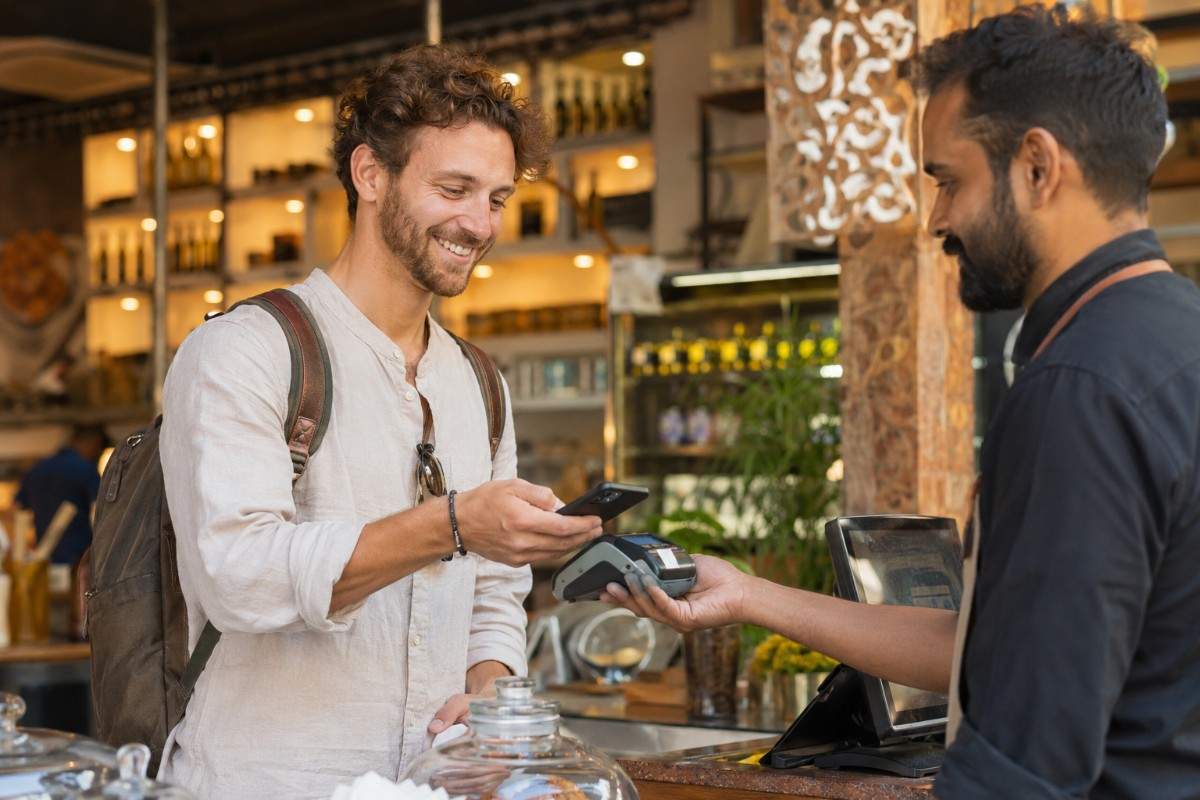
Say you are standing at a street stall somewhere in India, the kind of place selling the best chai you have tasted for Rs 20. You hold up your Visa card, and the vendor shakes his head, points to a QR code taped to the counter. You open your banking app, hold your phone up, and nothing happens. The ATM around the corner charges $5 before your bank adds its own 3% markup. The exchange counter near your hotel takes 6% off every note. You have spent more accessing your money than on anything you came here for.
Foreign tourists can use UPI in India, but not through the apps locals use. The route is a regulated Prepaid Payment Instrument (PPI) wallet that loads your international Visa or Mastercard onto India’s UPI network. No Indian bank account, no local SIM, and no branch visit before you arrive. You load the wallet, scan any QR code, and pay at 55 million+ merchants exactly the way any local does. Who qualifies, what it costs, the RBI limits that apply, and how to set it up before your flight are all covered below.
Key Highlights
- Foreign tourists from 180+ countries can use UPI in India through a Prepaid Payment Instrument (PPI) wallet
- A PPI wallet is not a bank account. It is a regulated digital wallet linked to the UPI network
- For most nationalities, there is no joining fee. Russian tourists pay a one-time fee of Rs 999 (around $12). The loading fee is 2.95% for all users
- Merchant payments are free. Every QR code scan costs Rs 0
- Daily spending limit is Rs 1,00,000 (around $1,200)
- Verification is required. You can complete it at 16 city branches or via doorstep visit in 4 cities
- You can download the app and upload documents before landing in India
Why Your Foreign Visa or Mastercard Fails at UPI QR Codes
UPI runs on a domestic payment rail managed by NPCI. Visa and Mastercard are international networks. A UPI QR code links to a UPI ID, not a card terminal. Your foreign card has no direct connection to that system, so payment fails at the point of scan.
The fix is a PPI wallet that sits natively on the UPI rail. Once loaded, your wallet behaves exactly like a local user’s account at every merchant.
The Route That Works for Tourists
A Prepaid Payment Instrument wallet is the RBI-approved solution for foreign tourists. You load INR into the wallet using your international Visa or Mastercard. From that point, every UPI QR code in India accepts your payment.
CheqUPI runs on Transcorp International’s PPI and Authorised Dealer Category II licence, issued by the RBI. It is a named issuer app within NPCI’s UPI One World framework, recognised at the India AI Impact Summit 2026.
Who Can Use UPI as a Foreign Tourist? Eligibility Explained

Foreign tourists from 180+ countries can use CheqUPI. The exclusion criterion is the FATF framework. FATF is the Financial Action Task Force, an international body that flags countries with weak anti-money laundering controls. Countries on its blacklist or greylist cannot access the service.
Eligibility is far wider than just G20 nations. Visitors from Vietnam, Indonesia, South Korea, Thailand, Argentina, and dozens more are all eligible. If your country is not on the FATF exclusion list, you almost certainly qualify.
Countries That Are Not Eligible
The following countries are excluded under FATF alignment:
Albania, Barbados, Burkina Faso, Cambodia, Cayman Islands, Haiti, Jamaica, Jordan, Mali, Malta, Morocco, Myanmar, Nicaragua, Pakistan, Panama, Philippines, Senegal, South Sudan, Syria, Turkey, Uganda, Yemen.
If your passport is from one of these countries, CheqUPI is not available to you. For everyone else, the app confirms eligibility during sign-up in under a minute.
What About NRIs?
NRIs are split into two groups under CheqUPI’s rules. If you hold a foreign passport, you follow the tourist wallet route. If you hold an Indian passport, you access a separate wallet that requires an Indian identity document alongside your foreign driving licence. Both routes work. The documents differ.
How CheqUPI Works for Foreign Tourists

CheqUPI is a named issuer app for NPCI’s UPI One World facility. The process runs in four steps: download, register, complete verification, load and pay.
You download the app, verify your mobile number via OTP, upload passport details and a selfie, then complete verification. After that, you load funds and pay at any UPI merchant.
Step-by-Step Setup
- Download the CheqUPI app on Android or iOS
- Enter your mobile number and verify via OTP
- Upload your passport details and a selfie
- Book a verification appointment at a branch or a doorstep visit
- Bring original documents for verification
- Load your wallet using your international card
- Scan any UPI QR code to pay
Verification Options: Branch or Doorstep
Verification is required under current RBI guidelines for foreign national PPI wallets. Two options are available.
Branch visit: 16 cities across India. Ahmedabad, Amritsar, Bangalore, Bhubaneswar, Chandigarh, Chennai, Delhi (Dwarka), Delhi (Nehru Place), Gurgaon, Hyderabad, Jaipur, Jalandhar, Kolkata, Mumbai (Andheri), Mumbai (Fort), Visakhapatnam.
Doorstep visit: Available in Goa, Kochi, Varanasi, and Agra. Book via WhatsApp.
Verification typically takes between 5 to 10 minutes. You can upload your documents before landing to cut waiting time after arrival.
Documents You Need
| Wallet type | Documents required |
| Tourist wallet (foreign passport) | Original passport, valid Indian visa or e-visa, immigration entry stamp |
| NRI wallet (Indian passport) | Original passport, foreign driving licence or equivalent, Aadhaar or PAN card |
What Does It Cost?
For most nationalities, there is no joining fee. Russian tourists pay a one-time joining fee of Rs 999 (around $12). Every time you load funds, 2.95% applies. Every time you pay a merchant, the fee is Rs 0.
Here is how that compares to the alternatives.
| Payment method | Upfront cost | Loading or conversion fee | Merchant payment fee |
| CheqUPI | Free for most nationalities. Rs 999 ($12) for Russian tourists | 2.95% per load | 0% |
| Airport money changer | None | 8% to 9% per conversion | N/A |
| International card swipe | None | 1% to 4% bank markup | Dynamic currency conversion risk |
| ATM withdrawal in India | None | $5 fixed + 1% to 3% | N/A |
Note: Fees may vary. Always check current rates at chequpi.com/faqs before you travel.
On a trip where you load $600 worth of rupees, CheqUPI costs around $18 in loading fees for most nationalities. A 6% money changer on the same amount costs $36 before you spend a single rupee.
Spending Limits for Foreign Tourists
The RBI sets volume and frequency limits for foreign national PPI wallets. These are the limits that apply to your CheqUPI wallet.
| Limit type | Amount (INR) | Amount (USD approx) |
| Daily spending cap | Rs 1,00,000 | $1,200 |
| Monthly spending cap | Rs 2,00,000 | $2,400 |
| Monthly add-money cap | Rs 3,00,000 | $3,600 |
| Per transaction (payments) | Rs 80,000 | $950 |
| Per transaction (add-money) | Rs 70,000 | $840 |
| Daily transaction count | 20 transactions | N/A |
| New user cap, first 24h (Android) | Rs 50,000 | $600 |
| New user cap, first 72h (iOS) | Rs 50,000 | $600 |
Note: Limits are set by the RBI and may change. Check chequpi.com/faqs for the latest figures before your trip.
For most tourists, Rs 2,00,000 per month is more than enough. A 14-day trip works out to around Rs 14,000 a day, roughly $165, which covers food, transport, and sightseeing comfortably.
One Rule to Know Before You Pay
Your CheqUPI wallet is designed primarily for merchant (P2M) payments. Under RBI regulations, peer-to-person (P2P) transfers are restricted to Indian nationals only, with a maximum limit of 10 transactions per day. Transfers to other foreign nationals are not supported.
In practice, this affects very informal settings. A registered restaurant, hotel, chain store, or app-based service like Ola or Uber uses a merchant UPI ID and works every time. A roadside vendor using a friend’s personal UPI handle may not work.
Keep $25 to $35 in cash for situations like these. For everything else, the wallet covers you across 55 million+ merchants.
Is CheqUPI Safe?
CheqUPI operates under an RBI-licensed PPI framework. Your funds sit in escrow accounts at scheduled commercial banks, ring-fenced from the company’s own finances. Every transaction requires two-factor authentication. The platform’s risk systems block suspicious activity before it is processed.
The FATF-aligned eligibility rules also mean the platform operates within international anti-money laundering standards. For more on travelling safely in India, our safety guide covers what to watch for on the ground.
Set Up Before You Land
One real advantage CheqUPI has over kiosks and forex cards is pre-arrival registration. You can download the app, enter your passport details, and upload documents before your flight.
Verification happens after you arrive. But you walk off the plane already registered. That means activation within an hour of landing rather than starting from zero. It also means one less thing to sort when you are jet-lagged and searching for your first meal.
Use the pre-arrival window to plan your India trip budget and decide how much to load on day one.
Conclusion
Foreign tourists can use UPI in India. The route is a regulated prepaid wallet that links your international card to India’s UPI network. Free to join for most nationalities, 2.95% to load, and zero fees at every merchant across 55 million+ locations. Set it up before you fly, complete verification within an hour of landing, and India’s entire digital payment system opens up.
Frequently Asked Questions
- Can a tourist use UPI in India without an Indian bank account?
Yes. A PPI wallet like CheqUPI links your international card to UPI. No Indian bank account or Indian SIM card is needed. - Which countries are eligible to use UPI as a foreign tourist in India?
Tourists from 180+ countries are eligible. Citizens of FATF blacklisted or greylisted countries, including Pakistan, Turkey, and Myanmar, cannot use CheqUPI. - Why does my Visa card not work with UPI QR codes in India?
UPI runs on a domestic payment rail. Visa and Mastercard have no direct connection to it. A PPI wallet converts your card balance into a UPI-linked INR wallet. - Can I use PhonePe or Google Pay as a foreign tourist in India?
No. Both apps require an Indian bank account. Foreign tourists need a dedicated PPI wallet like CheqUPI to access UPI. - What documents do I need to activate UPI as a foreign tourist?
You need your original passport, a valid Indian visa or e-visa, and an immigration entry stamp showing your date of arrival. - What is the daily spending limit for foreign tourists using UPI in India?
The daily spending cap is Rs 1,00,000 (around $1,200). You can make up to 20 transactions per day, with a maximum of Rs 80,000 per payment. - Can I send money to another person using a tourist UPI wallet?
Under RBI rules, P2P transfers are permitted strictly to Indian nationals only, capped at 10 transactions per day. Transfers to other foreign nationals are not supported. - How long does verification take for foreign tourists in India?
Verification typically takes 20 to 60 minutes. Uploading your documents before landing reduces the time needed after arrival. - What happens to my UPI wallet when my India visa expires?
Under RBI rules, the wallet closes on visa expiry. Any unused balance is returned to your source account. - Can I reload my CheqUPI wallet more than once during my trip?
Yes. You can reload as often as needed, up to a monthly add-money cap of Rs 3,00,000 (around $3,600) and a per-transaction reload limit of Rs 70,000 (around $840).
“India runs on UPI, and your foreign card will not get you far without it. Download the CheqUPI app, register before your flight, and pay like a local from the moment you land. Download CheqUPI and activate your wallet today.”