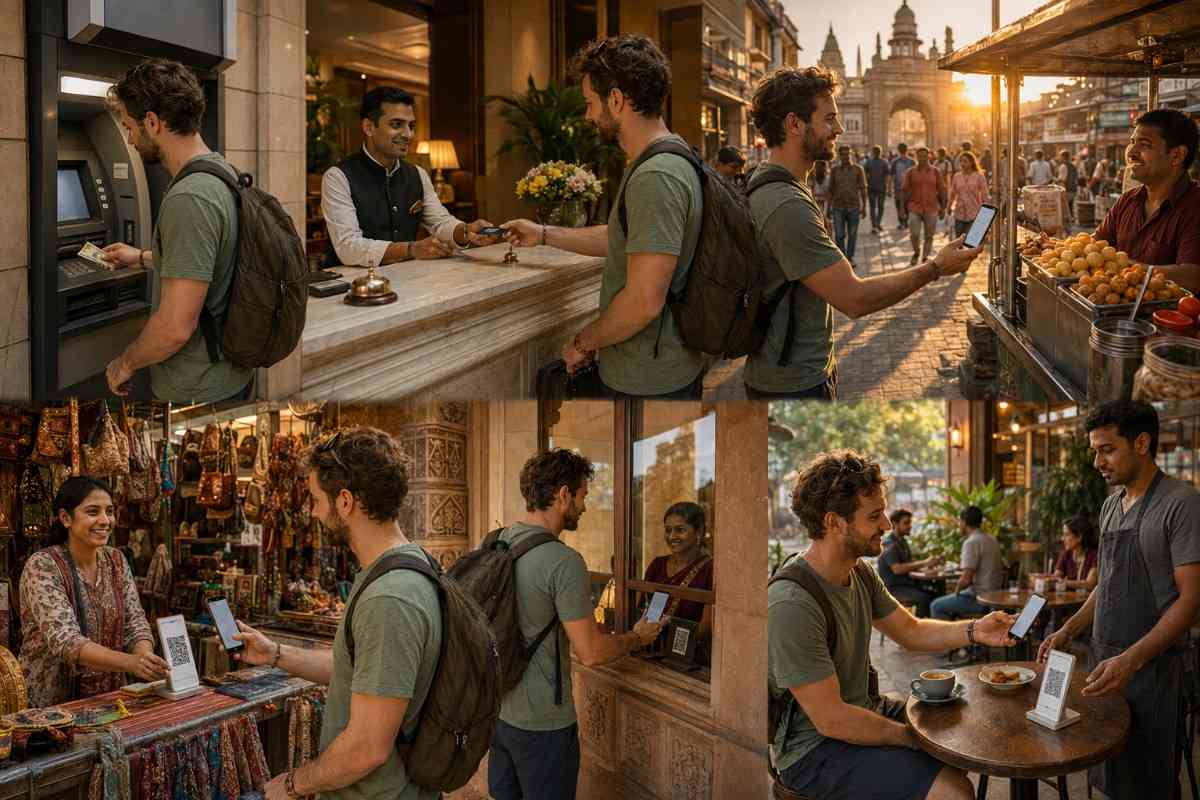
India is one of the fastest-moving payment economies in the world, and most foreign tourists only find this out after their card gets declined at a chai stall, a market, and a museum ticket counter on the same afternoon. Cash runs out, cards fail silently, and the vendor just points at a QR code on the wall while the queue grows behind you.
Three payment methods dominate India in 2026, each with different costs, different acceptance, and different use cases. Pick the right combination before you land and you will not lose a single rupee to fees, failed transactions, or ATM queues.
Key highlights
- India processed over 21 billion UPI transactions in January 2026 alone. QR-code payments are the default for most merchants, not the exception.
- International cards fail at many Indian merchants due to India’s OTP security system, which requires an Indian phone number to complete transactions.
- Cash ATM withdrawals in India typically cost Rs 200 to Rs 500(approx $2.1 to $5.25) in bank fees plus a 3% to 5% currency conversion markup per withdrawal.
- CheqUPI is free to join for all eligible nationalities. The wallet loading fee is 2.95% + applicable taxes for all foreign users. There are no transaction fees when paying merchants through UPI.
- Every merchant payment made via UPI after loading costs zero.
- CheqUPI is free to join for all eligible nationalities.It works at 55 million+ merchants across India.
Why paying in India is different from anywhere else
India’s payment infrastructure did not evolve the way most countries’ did. It skipped the card terminal era almost entirely and jumped straight to mobile QR payments. That shift happened fast, and it caught most international tourists off guard.
The OTP and gateway problem with international cards
When you try to pay with an international Visa or Mastercard at an Indian merchant or on an Indian platform, many domestic payment gateways block the transaction at the gateway level before it even reaches the OTP step. This affects not just card terminals but also online bookings on Indian platforms including food delivery apps, train ticketing sites, and hotel portals. Getting the OTP on your foreign number does not fix this because the card is often rejected before that step begins.
Apple Pay works in India if your home international card supports contactless payments, but only at merchant terminals that accept tap-to-pay. The problem is that most Indian merchants do not have card terminals at all. They use UPI QR codes, and Apple Pay cannot connect to those. Virtual cards from international wallets face the same limitation. Even physical cards from reputable international banks get declined wherever merchants have switched entirely to QR-based UPI payments and no longer maintain a card terminal.
How India leapfrogged cards entirely with UPI
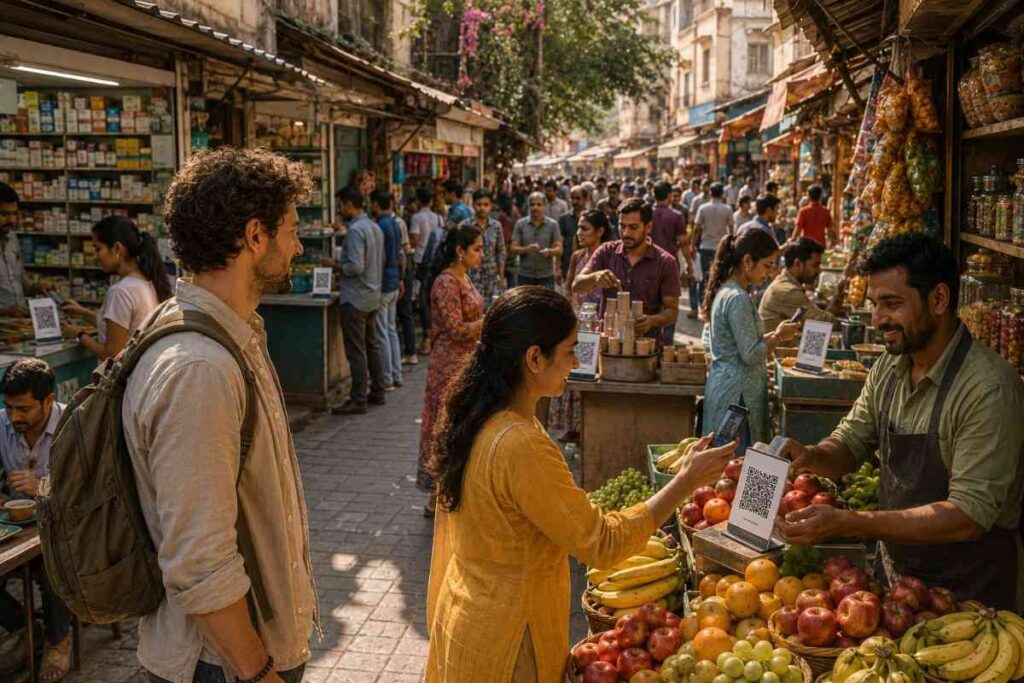
UPI, the Unified Payments Interface, was launched by the National Payments Corporation of India (NPCI) in 2016. By 2026 it has become the default payment method for the vast majority of Indian commerce, from five-star hotels to roadside chai stalls. A merchant displays a QR code. A customer scans it, enters a PIN, and payment completes in under three seconds.
The problem for tourists is that UPI was originally built for Indian bank account holders with Indian phone numbers. A foreign traveller on a tourist visa cannot open an Indian bank account, which means standard UPI apps like PhonePe and Google Pay are not accessible. RBI-licensed prepaid wallets like CheqUPI changed that by creating a bridge between international cards and India’s UPI network.
Option 1: cash (Indian rupees)
Cash is universally accepted in India. It is also expensive to access and increasingly inconvenient to use as more merchants go QR-only.
Where cash still works
Cash remains essential in specific situations. Remote areas and rural markets often have no digital payment infrastructure at all. Temple donation boxes, small ferry operators, village guesthouses, and some roadside vendors in tier-three towns are cash-only. A small reserve of physical rupees is a practical necessity, not an optional extra.
What cash actually costs you
Getting rupees is where the fees stack up. An airport currency counter typically offers a rate 8% to 9%. ATM withdrawals come with a fixed fee from your home bank, a currency conversion markup of 3% to 5%, and a local ATM operator surcharge of around Rs 150 to Rs 300(approx $1.6 to $3.3) per transaction. On a Rs 10,000 withdrawal, total fees can reach Rs 400 to Rs 700, depending on your card issuer.
Carry Rs 5,000 to Rs 10,000 in small denominations as a backup reserve. Do not treat cash as your primary payment method. The cost per transaction is too high, and the change problem, where merchants cannot break larger notes, adds friction to every small purchase.
Option 2: international card
International cards work in India, but only in specific places and under specific conditions.
Where cards work in India
Large hotel chains, international airport retail, major supermarkets, upscale restaurants, and domestic airline counters all accept Visa and Mastercard reliably. If a merchant has a physical card terminal and processes international transactions regularly, your card will likely work. ATMs operated by major banks like SBI, HDFC, ICICI, and Axis accept foreign cards for cash withdrawals.
Where cards fail and why
Indian domestic payment gateways frequently block international cards at the gateway level, which means your card is likely to be declined even before an OTP step is reached. Online transactions on Indian platforms are a particular weak point. Booking a domestic train, ordering from a food delivery app, or paying a local tour operator online will frequently fail with an international card, even if the merchant technically accepts Visa.
Budget guesthouses, local transport operators, market traders, and the vast majority of restaurants outside hotel dining rooms will not have a card terminal at all. Apple Pay works at contactless tap-to-pay terminals with foreign international cards, but most Indian merchants do not have card terminals. They use UPI QR codes, and Apple Pay cannot connect to those.
Option 3: UPI wallet via CheqUPI
A UPI wallet for tourists is an RBI-licensed Prepaid Payment Instrument. It gives you a UPI ID tied to a wallet balance, so you can scan any merchant QR code in India and pay instantly, exactly the way every local does, without needing an Indian bank account or phone number.
What a UPI wallet actually is
CheqUPI is built on Transcorp International’s PPI and Authorised Dealer Category II licence, backed by Y Combinator (W22). You download the app, complete a one-time identity verification using your passport and visa, and load funds using your international credit or debit card. From that point, you scan and pay at any UPI merchant in India. The wallet supports Person-to-Merchant (P2M) payments only. P2P transfers to individual UPI IDs are not supported for foreign national wallets under RBI regulations.
For a full walkthrough of how UPI works in India for foreign tourists, see our complete UPI guide.
What CheqUPI costs and how it works
The loading fee is 2.95% + applicable taxes for all foreign users. On top-ups below Rs 10,000, an additional Rs 150 applies. On a Rs 20,000 load, the total fee works out to roughly Rs 700 to Rs 750, including tax. Every merchant payment via UPI after that is free. CheqUPI is free to join for all eligible nationalities.
Side-by-side cost comparison
| Feature | Cash | International card | CheqUPI UPI wallet |
| Access or loading cost | 3% to 5% conversion + ATM fees | 1% to 3% foreign transaction fee | The loading fee is 2.95% + applicable taxes for all foreign users. |
| Merchant payment fee | Zero | Zero (where accepted) | Zero |
| ATM access | Yes, with fees | Yes, with fees | Not applicable |
| Merchant acceptance | Universal but declining | Large chains and hotels only | 55 million+ UPI merchants |
| Works without Indian bank account | Yes | Yes | Yes |
| Works at street vendors and local markets | Increasingly not accepted | No | Yes |
| OTP barrier risk | None | High | None |
Which payment method to use when
No single option covers every situation in India. The tourists who move through India with the least friction use all three, but in very different proportions.
Use UPI for daily spending
A UPI wallet covers street food, local restaurants, auto-rickshaws, markets, museum entry tickets, pharmacies, guesthouses, and the vast majority of daily transactions. Load Rs 15,000 to Rs 25,000 after activation of your wallet and use it as your primary payment method throughout the trip.The loading fee is a one-time cost that is lower than what most tourists lose to ATM fees in the first two days.The loading fee is 2.95% + applicable taxes for all foreign users.
Keep a card for hotels and online bookings
Large hotel chains process international cards reliably. Use your card at check-in for the hold, for domestic flight bookings made through international platforms, and for any purchase where you need a card receipt for expense reporting. Keep it as a backup ATM option if your wallet balance runs low before your next top-up.
Keep cash for remote areas and small vendors
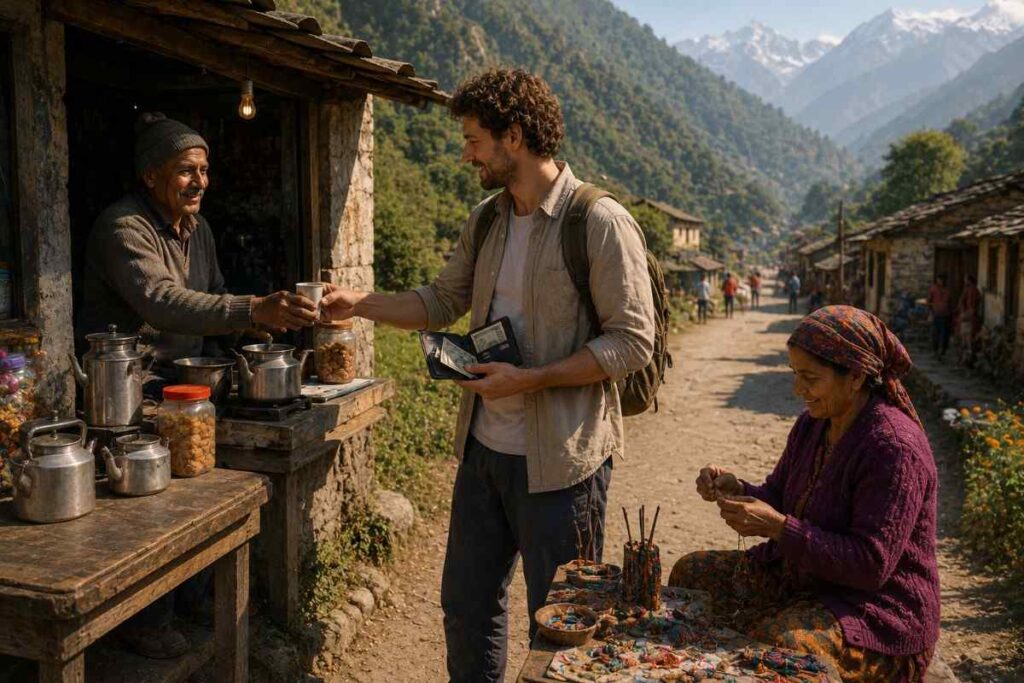
Some situations in India are still genuinely cash-only. River boat operators in Varanasi, village markets in Rajasthan, small dhaba stalls in hill stations, and donation boxes at temples often have no QR code and no card terminal. Rs 5,000 in small notes handles these situations without drama. Withdraw from a bank-branch ATM rather than an airport counter to avoid the worst exchange rates.
Conclusion
India’s payment system is one of the most advanced in the world, and one of the least accessible to tourists arriving without the right setup. A UPI wallet solves the biggest problem: it puts 55 million QR-code merchants within reach of your international card. Use it for daily spending, keep your card for large purchases, and carry a small cash reserve for situations where nothing digital reaches. That combination covers India completely.
FAQs
What is the best way to pay in India as a tourist?
A UPI wallet like CheqUPI for daily spending, an international card for hotels and online bookings, and Rs 5,000 to Rs 10,000 cash for remote areas and small vendors.
Can I use my Visa or Mastercard in India?
Yes, but only at larger hotels, airports, and major chain retailers. Most small merchants and local restaurants accept UPI QR payments only and do not have card terminals.
Why does my international card not work in India?
India’s payment system requires a one-time password sent to a registered Indian phone number to complete many transactions. Foreign numbers do not qualify, so most international cards fail at Indian merchants.
Should tourists carry cash in India?
Yes, but only as a backup. Keep Rs 5,000 to Rs 10,000 in small notes for remote areas, temple donations, and vendors without QR codes. ATM fees make cash expensive as a primary payment method.
Is UPI free for tourists in India?
CheqUPI is free to join for all eligible nationalities. The wallet loading fee is 2.95% + applicable taxes for all foreign users, plus tax loading fee when you top up your wallet. Every merchant payment via UPI after that is free. There is no per-transaction fee on merchant payments.
What is CheqUPI, and how does it work?
CheqUPI is an RBI-licensed UPI wallet for foreign tourists and NRIs. You load it using your international card and pay at any UPI merchant in India by scanning a QR code. No Indian bank account is needed.
How much cash should I carry in India?
Rs 5,000 to Rs 10,000 in small denominations is enough as a backup reserve for most trips. Withdraw from bank-branch ATMs rather than airport counters to get better exchange rates.
What digital payment options are available for tourists in India?
RBI-licensed UPI wallets like CheqUPI are the most practical option. They work at 55 million+ merchants, load via international card, and require no Indian bank account.
Does Apple Pay work in India?
Yes, but only in limited situations. Apple Pay works if your international card supports contactless payments and the merchant has a tap-to-pay terminal. However, most Indian merchants accept UPI QR payments instead of card terminals, so a UPI wallet is usually the more practical payment option.
What is the cheapest way to pay in India as a tourist?
A UPI wallet via CheqUPI.The loading fee is 2.95% + applicable taxes for all foreign users, and it is a one-time cost per top-up. Every merchant payment after that is free, making it cheaper per transaction than ATM withdrawals across a full trip.
“Most tourists spend their first two days in India fumbling with cash and declined cards before someone points them toward a QR code. You do not have to do that. CheqUPI takes minutes to set up and works at 55 million+ merchants from the moment you land.Download CheqUPI. Activate your wallet after arriving in India and start paying with UPI in minutes.”