
I landed in India with two credit cards, one debit card, and zero cash. My plan was simple: swipe or tap my way through a two-week trip the same way I do back home. By day three, I had a phone full of declined-transaction screenshots and a growing pile of rupee notes I had not planned to carry.
Here is what actually happened when a foreign card met India’s payment reality. Where it sailed through, where it hit a wall, and the one change that would have saved me a lot of stress and money.
Key highlights
- Foreign credit cards work at most hotels, malls, and airport counters, but fail at the majority of India’s 55 million-plus UPI-only merchants.
- ATM withdrawals with a foreign debit card incur bank fees of 1% to 3%, plus a fixed surcharge of around $2 to $5 per withdrawal.
- Airport and hotel money changers charge an 8% to 9% markup over the mid-market exchange rate.
- Dynamic currency conversion at Indian card terminals can add another 3% to 5% on top of your bank’s own rate.
- In many parts of India, especially among small merchants, UPI QR payments have largely replaced card terminals.
- A Prepaid Payment Instrument wallet like CheqUPI loads your foreign card once with a loading fee of 2.95% + applicable taxes and pays every QR merchant with a 0% merchant fee.
The airport made me overconfident
The card worked perfectly for the first few hours. I tapped it at a coffee chain inside the terminal. I swiped it at the prepaid taxi counter. The hotel check-in went through without a hitch. India felt no different from London or New York at that point.
That confidence lasted exactly until the next morning. I walked out of the hotel to a row of breakfast stalls, each with a small printed QR code taped to the counter. Not one had a card machine. The vendor smiled, pointed at the QR code, and said “Paytm ya PhonePe.” I had neither.
I handed over a Rs 500 note for an Rs 80 meal. The vendor shrugged and gave me change in coins. My first lesson: the airport is not India.
Where the foreign card still worked
Hotels, malls, and chain restaurants
Large hotels, branded restaurants, and shopping malls almost always have card terminals. Visa and Mastercard go through at these spots without trouble. American Express is rarer. Virtual cards and Apple Pay are a near-total blank; Apple Pay cannot be used to scan and pay UPI QR codes.
The catch is the fee. My bank added a 1.5% foreign transaction fee on every swipe. A Rs 2,000 dinner (approx $21) cost me an extra Rs 30 (approx $0.32) in fees I did not see until my statement arrived. Small per meal, but it adds up over 14 days.
ATM withdrawals and the real cost
I pulled cash from ATMs three times during the trip. Each withdrawal triggered three separate charges: a fixed ATM operator fee of Rs 200 to Rs 350 (approx $2 to $4), my bank’s own 2% foreign withdrawal fee, and a currency conversion spread. On a Rs 10,000 withdrawal (approx $106), I paid roughly Rs 550 (approx $6) in combined charges. That is a 5.5% effective cost just to hold cash.
Most Indian ATMs cap a single foreign-card withdrawal at Rs 10,000 to Rs 20,000. To get enough cash for a few days, I needed multiple withdrawals, each with its own fee stack.
Where the foreign card stopped working
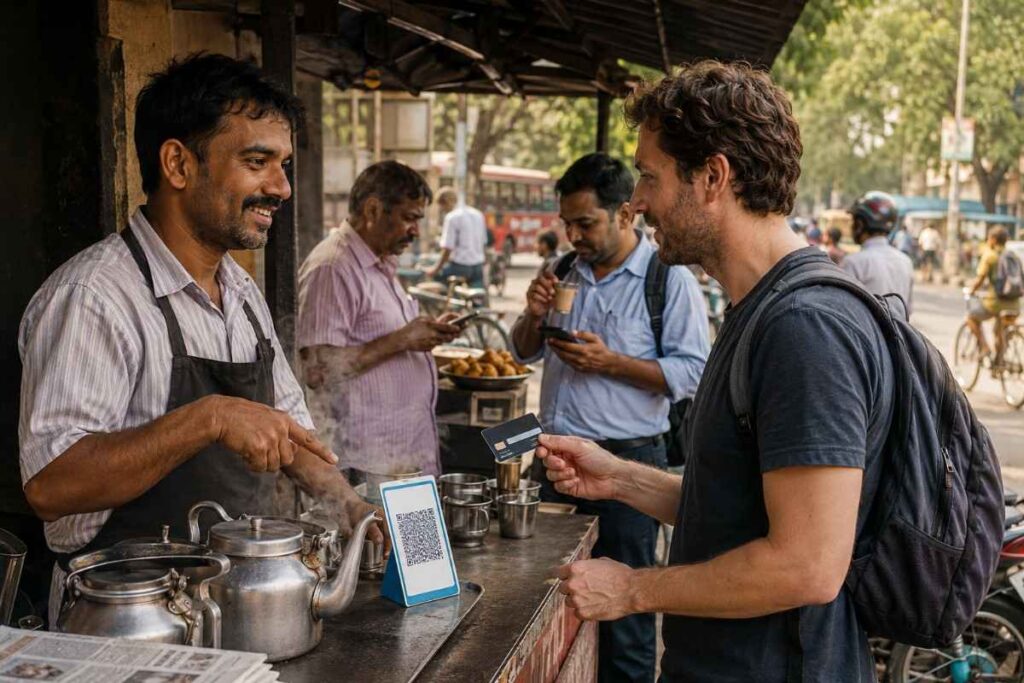
The tea stall with only a QR code
India has moved past the card terminal. The tea stall, the juice cart, the neighbourhood bakery, the laundry service at a guesthouse, all of them now run on UPI QR codes. No card slot. No tap terminal. Just a printed square on the wall.
My foreign Visa was useless here. UPI runs on India’s domestic payment rails. A foreign-issued card cannot scan a UPI QR code directly. The vendor does not care about your card network. They want a UPI payment or cash.
This is not a fringe problem. UPI processed over 16 billion transactions in a single month in 2025, according to NPCI data. The street-level economy runs on it.
Auto drivers and small shops
Auto rickshaw drivers were the next wall. Most use personal UPI IDs, not registered merchant accounts. Even if I had a UPI wallet, these would be Person-to-Person transfers, which foreign national wallets do not support under RBI rules. Cash was the only option here.
Small electronics shops, pharmacies, and local restaurants outside tourist zones told the same story. A few had old card machines gathering dust. Most just had the QR code. If you want to carry less cash and stay safe in India, you need a way onto the QR network.
The fees I only saw on my bank statement
The real cost of relying on a foreign card in India only showed up two weeks later. My statement listed charges I never agreed to at the point of sale.
| Fee type | How it hits you | Typical cost |
| Foreign transaction fee | Bank charges on every card swipe abroad | 1% to 3% of the amount |
| Dynamic currency conversion | Merchant terminal converts to your home currency at a bad rate | 3% to 5% markup |
| ATM withdrawal fee | Fixed fee per withdrawal plus bank percentage | $5 fixed + 1% to 3% |
| Airport money changer | Cash exchange at arrival or departure | 8% to 9% over mid-market rate |
Dynamic currency conversion is the one that stings most. A merchant terminal offers to charge you in dollars or pounds “for your convenience.” It looks helpful. The conversion rate is almost always 3% to 5% worse than your bank’s own rate. Always choose to pay in INR and let your own bank convert.
If you are building a realistic India travel budget, factor in at least 3% to 6% on top of every card transaction. That is the hidden tax of using a foreign card as your only payment method in India.
What I would do differently
Keep the foreign card for hotel bills, mall shopping, and emergency ATM withdrawals. Use a Prepaid Payment Instrument wallet for everything else. That is the split that makes sense.
CheqUPI is the wallet I wish I had known about before the trip. It is free to join, and it works with any international Visa or Mastercard. You load rupees onto the wallet from your foreign card at a 2.95% plus tax loading fee. After that, every merchant payment by UPI QR costs 0%.
The math is direct. A Rs 10,000 load (approx $106) costs roughly Rs 295 (approx $3) in loading fees. That same Rs 10,000 spent across card swipes would cost Rs 300 to Rs 600 in foreign transaction fees, DCC markups, and ATM charges. For many travellers, the total cost can be lower than relying exclusively on foreign card payments, ATM withdrawals, and exchange counters.
CheqUPI works at any of India’s 55 million-plus UPI merchants. Tea stalls, restaurants, pharmacies, train ticket counters, and grocery stores. In most places where a merchant accepts UPI QR payments. Foreign national wallets support Person-to-Merchant payments only, which covers every registered business. You do not need an Indian bank account or an Indian SIM card. An internet connection and location access are required.
After you download the app, a quick verification step takes 5 to 10 minutes once you arrive in India. Then you load funds and start scanning. If you want the full walkthrough, the guide on how UPI works for foreign travellers in India covers every step.
The verdict: card plus wallet beats card alone
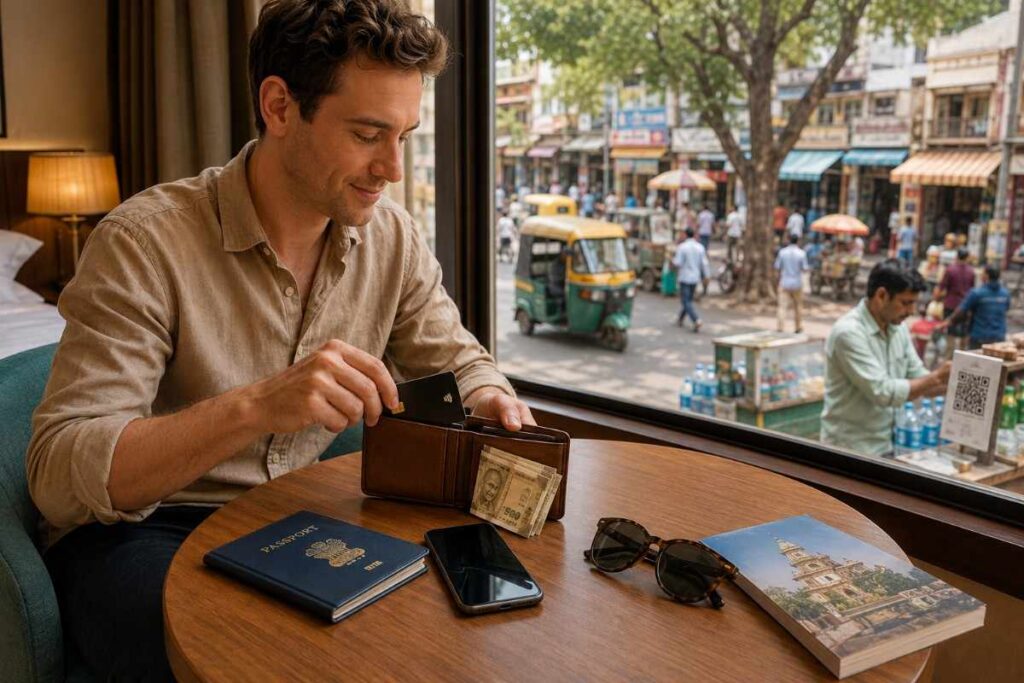
A foreign card is not broken in India. It just covers about 20% of the places you will actually spend money. The other 80% runs on UPI, and your card cannot touch it without a wallet in between.
If I did the trip again,Download CheqUPI before your trip and activate your wallet once you’re in India, carry a small amount of cash (5000 Rs to 10000 Rs) for auto rides and tips, and keep one credit card as a backup for hotels. That three-layer setup covers every payment scenario India throws at you.
FAQs
1.Can I use only a foreign card in India?
You can use it at hotels, malls, and airports. Most small shops and street vendors accept only UPI or cash, so a card alone will not cover daily spending.
2.Why is my foreign card declined at Indian shops?
Most small Indian merchants use UPI QR codes, not card terminals. Your foreign card cannot connect to UPI directly. You need a wallet or cash.
3.Do Indian street vendors accept foreign cards?
Almost never. Street vendors, tea stalls, and local restaurants rely on UPI QR payments. A foreign card has no way to scan those codes without a wallet.
4.What fees does a foreign card trigger in India?
Foreign transaction fees (1% to 3%), dynamic currency conversion (3% to 5%), and ATM surcharges ($5 plus 1% to 3%). These stack on each other.
5.Is dynamic currency conversion worth accepting?
No. Always pay in INR. DCC rates are 3% to 5% worse than your own bank’s conversion rate. Decline the offer at the terminal every time.
6.Can foreign travellers use UPI in India?
Yes. Foreign travellers from 180-plus FATF-compliant countries can use a Prepaid Payment Instrument wallet like CheqUPI to make UPI QR payments.
7.Does Apple Pay work at Indian merchants?
Apple Pay works at a few NFC-enabled terminals in large stores. It cannot scan UPI QR codes, which account for the vast majority of Indian retail payments.
8.How much cash should a tourist carry in India?
Carry Rs 2,000 to Rs 5,000 (approx $21 to $53) for auto rides, tips, and vendors who take only cash. A UPI wallet handles the rest.
9.What is the cheapest way to pay in India as a tourist?
Load a UPI wallet like CheqUPI at 2.95% plus tax, then pay merchants at 0% fee. That beats card swipe fees and money changer markups by a wide margin.
10.Can I load my foreign card into a UPI wallet?
Yes. CheqUPI accepts international Visa and Mastercard. You load INR onto the wallet and pay any UPI merchant directly by scanning their QR code.
“Your foreign card got you to India. Now let CheqUPI handle the other 55 million merchants your card cannot reach. The loading fee is lower than what you are already losing to hidden bank charges, and every QR payment after that is free.Download CheqUPI before your trip and activate your wallet once you’re in India.”