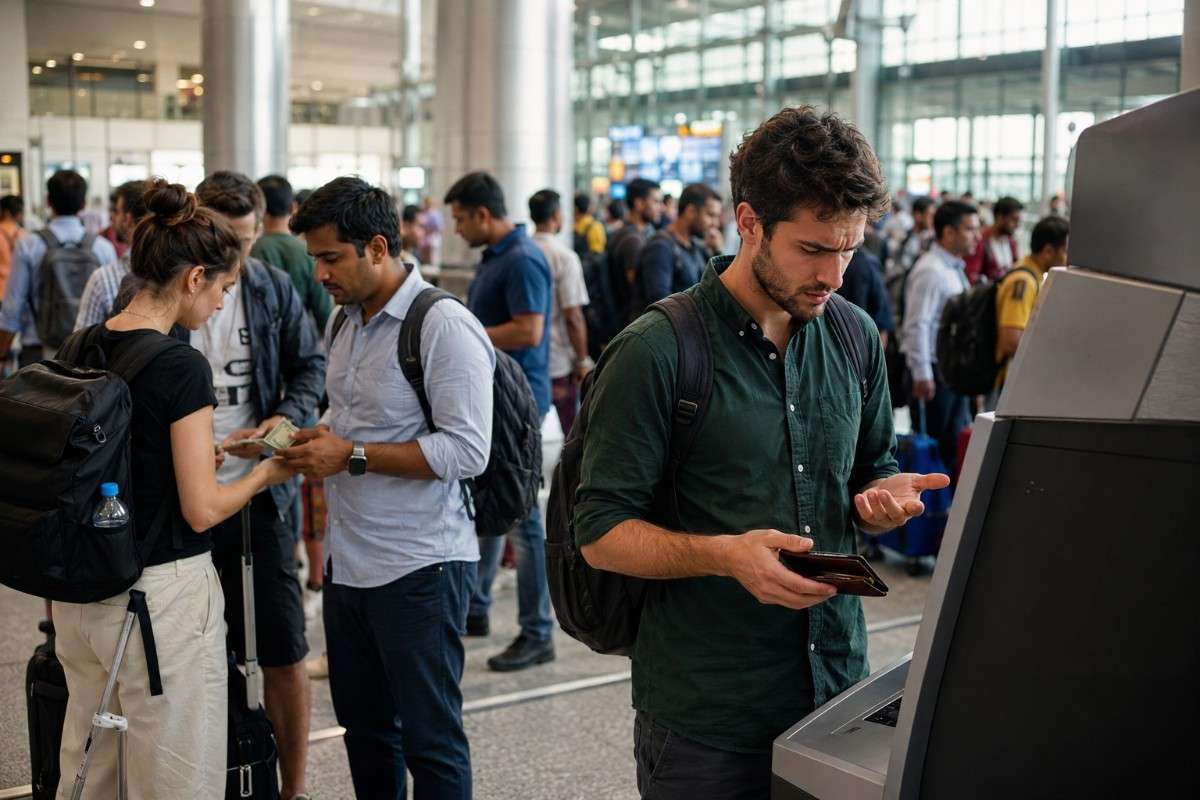
You land in India, find an ATM at the airport, and withdraw Rs 10,000 (approx $106). It works. You assume ATMs will carry you through the trip the way they do in Europe or the US. By day four, you have hit a declined transaction, a Rs 10,000 cap that forces multiple withdrawals, and a bank statement showing three separate fee layers on every single one.
India’s ATM system works for domestic users. For a foreign card, it is a maze of low limits, stacked charges, and machines that sometimes just say no. Here are the six problems you will face, what they cost over a two-week trip, and the one fix that most ATM guides leave out entirely.
Key highlights
- Indian ATMs cap foreign card withdrawals at Rs 10,000 to Rs 20,000 (approx $106 to $213) per transaction, depending on the bank.
- Private bank ATMs charge Rs 150 to Rs 335 (approx $1.60 to $3.55) per foreign card transaction on top of your home bank’s own fees.
- Your home bank typically adds 1% to 3% as a foreign transaction fee plus a currency conversion spread on every withdrawal.
- Dynamic currency conversion at ATMs can add another 3% to 5% if you accept the machine’s offer to charge in your home currency.
- Public sector bank ATMs like SBI and Bank of India generally do not charge foreign card access fees.
- A UPI wallet like CheqUPI loads your foreign card once at 2.95% plus tax and pays every QR merchant at 0%, sidestepping ATM fees entirely for daily spending.
The six ATM problems nobody warns you about
Low per-transaction limits
Most Indian ATMs cap foreign card withdrawals at Rs 10,000 (approx $106) per transaction. Some banks allow up to Rs 20,000 (approx $213). That is the ceiling for a single withdrawal.
If you need Rs 30,000 (approx $319) for a few days of spending, you make three separate withdrawals. Each one triggers its own fee. The low cap is a security measure set by Indian banks, but for foreign travelers, it turns a simple cash run into an expensive ritual.
Fees that stack three layers deep

Three separate charges hit your account on every ATM withdrawal. First, the Indian ATM operator charges an access fee. Private banks like HDFC, ICICI, and Axis charge Rs 125 to Rs 335 (approx $1.33 to $3.55) per transaction for foreign cards.
Second, your home bank adds its own foreign transaction fee. This typically runs 1% to 3% of the withdrawal amount. Third, your home bank applies a currency conversion spread on top of the interbank exchange rate.
On a single Rs 10,000 (approx $106) withdrawal, these three layers can cost Rs 400 to Rs 700 (approx $4.25 to $7.45). That is a 4% to 7% effective fee just to hold your own cash. Public sector banks like SBI and Bank of India skip the first layer. But the other two still apply. Compare that to airport money changers in India, where markups run 8% to 9%, and ATMs look cheaper but still sting.
The dynamic currency conversion trap
Many Indian ATMs ask whether you want to be charged in rupees or your home currency. The screen makes it look helpful. If you choose your home currency, the ATM applies its own exchange rate. That rate is almost always 3% to 4% worse than your bank’s own rate.
Always choose rupees. Always decline the conversion. Let your own bank handle the exchange. This one choice saves 3% to 4% on every withdrawal.
Cards declined without explanation
Some foreign cards simply do not work at certain Indian ATMs. Revolut UK cards fail at Bank of India machines. HSBC UK cards work at some HDFC ATMs but not at others. The screen gives no reason. It just says “transaction declined.”
The fix is to try a different ATM from a different bank. Stick to SBI, HDFC, ICICI, Axis, and Citibank. Carry cards on at least two networks, one Visa and one Mastercard, so you always have a backup.
ATMs that run out of cash
Indian ATMs run out of cash more often than you might expect. Weekends, festivals, and month-end salary cycles drain machines fast. In smaller towns, a single ATM may serve the entire area and run dry by afternoon.
There is no warning on the screen until you try. The machine accepts your card, asks for your PIN, and then tells you funds are unavailable. You have wasted a trip, and, in some cases, your bank still logs it as a failed transaction.
No ATMs where you actually want to go
Major cities have ATMs on every block. Step outside and coverage drops fast. Hill stations, beach villages, temple towns, and rural tourist spots may have one ATM or none at all. If that single machine is empty or offline, you are stuck.
Carrying enough cash for remote areas is smart. But carrying large amounts of rupees brings its own risks, from pickpockets to the stress of counting unfamiliar denominations.
What these problems actually cost on a two-week trip
Here is the real math. Assume you need Rs 50,000 (approx $532) in cash over 14 days. With an Rs 10,000 (approx $106) per-transaction limit, that is five withdrawals.
| Fee type | Per withdrawal | Five withdrawals total |
| ATM operator fee (private bank avg.) | Rs 200 (approx $2.13) | Rs 1,000 (approx $10.64) |
| Home bank foreign fee (2% avg.) | Rs 200 (approx $2.13) | Rs 1,000 (approx $10.64) |
| Currency conversion spread (1% avg) | Rs 100 (approx $1.06) | Rs 500 (approx $5.32) |
| Total ATM cost | Rs 500 (approx $5.32) | Rs 2,500 (approx $26.60) |
Rs 2,500 (approx $27) is gone before you spend a rupee at a shop. That is a 5% tax on your own money. Accept the DCC conversion by mistake on even one withdrawal,, and the total climbs higher.
Now compare that to a UPI wallet. Loading Rs 50,000 (approx $532) onto CheqUPI at 2.95% plus tax costs roughly Rs 1,475 (approx $16). Every merchant payment after that costs 0%. The wallet saves you over Rs 1,000 (approx $11) on the same spending amount, and you never stand in front of an ATM. For a deeper look at how a wallet compares to a prepaid travel card, the forex card vs UPI wallet for India comparison lays out the full cost picture.
If you are weighing all your payment options, the guide on cash, card, or QR payments in India puts ATM fees in the context of a full trip budget alongside flights and hotels.
Note: Always check chequpi.com for the latest rates before you travel.
The fix most ATM guides do not mention
Every ATM guide tells you to use public sector banks, decline conversion, and withdraw in large amounts. Those tips help at the margins. But they do not address the core shift: India has moved past ATMs for daily spending. Over 55 million merchants accept UPI QR codes. The tea stall, the pharmacy, the restaurant, and the train ticket counter all run on QR.
Your foreign card cannot scan those QR codes. If you have ever wondered why international cards fail at Indian QR codes, the answer is simple: UPI runs on India’s domestic payment rails, and foreign-issued cards sit outside that network. A UPI wallet is the bridge.
CheqUPI is free to join and works with any international Visa or Mastercard. You load rupees at 2.95% plus tax, and every payment to a merchant by QR costs 0%. No ATM fee. No per-transaction conversion spread. No Rs 10,000 (approx $106) cap limiting how much you can access.
You do not need an Indian bank account or Indian SIM card. An internet connection and location access are required. After you download the app, a quick verification step takes 5 to 10 minutes once you arrive in India. CheqUPI has branches across India and is continuously expanding its network.
For the full setup walkthrough, the guide on how to set up UPI as a foreign tourist covers every step.
The wallet does not replace cash entirely. Auto drivers using personal QR codes, small tips, and vendors in areas without internet still need rupees in hand. But it covers roughly 80% of daily spending that a foreign card at an ATM handles badly and expensively.
When you still need an ATM and how to use one smartly
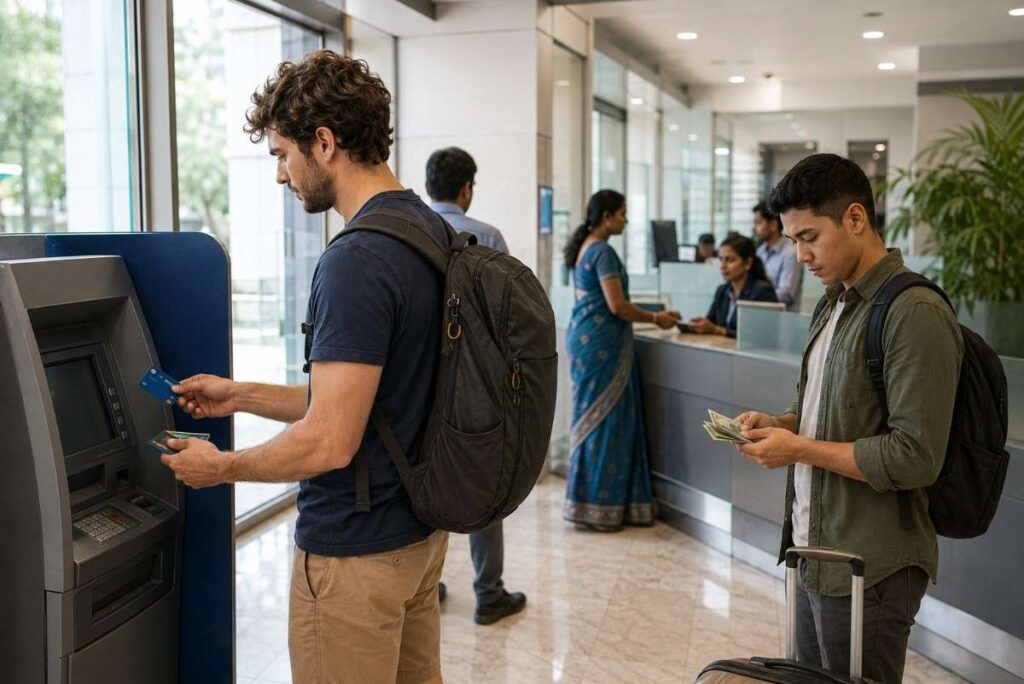
You will still need cash for auto rides. Most auto drivers use personal UPI accounts, and foreign national wallets support person-to-merchant payments only. Tips at hotels and restaurants also need cash. So does spending in remote areas with no mobile internet.
When you do use an ATM, three rules save money. First, stick to public sector banks. SBI and Bank of India ATMs generally charge no access fee to foreign cards. Second, always decline the conversion prompt. Choose to pay in INR and let your own bank convert.
Third, withdraw the maximum the machine allows per transaction. If the cap is Rs 10,000 (approx $106), withdraw the full amount rather than Rs 5,000 (approx $53) twice. Every separate transaction triggers its own fee stack.
Carry cards on two networks. If your Visa is declined at one bank, try a Mastercard at another. Airport ATMs are reliable for your first withdrawal after landing. After that, switch to SBI or Bank of India branches in the city for lower fees.
Conclusion
Indian ATMs work, but they charge foreign travelers three layers of fees on every withdrawal and cap each transaction at Rs 10,000 to Rs 20,000 (approx $106 to $213). Over a two-week trip, which adds up to Rs 2,500 (approx $27) or more on Rs 50,000 (approx $532) of spending.
A UPI wallet like CheqUPI cuts most of that cost. Load once, pay everywhere by QR, and save the ATM for the small amount of cash you actually need.
FAQs
1.Why is my foreign card not working at Indian ATMs?
Some Indian ATMs reject certain foreign card brands or issuers. Try a different bank’s ATM. Stick to SBI, HDFC, ICICI, or Axis. Carry cards on both the Visa and Mastercard networks.
2.How much can I withdraw from an Indian ATM?
Most ATMs cap foreign card withdrawals at Rs 10,000 to Rs 20,000 (approx $106 to $213) per transaction. Multiple withdrawals are possible, but each triggers separate fees.
3.What fees do Indian ATMs charge foreign cards?
Private banks charge Rs 150 to Rs 335 (approx $1.60 to $3.55) per transaction. Your home bank adds a 1% to 3% foreign transaction fee. A currency conversion spread applies on top.
4.Should I accept or decline conversion at Indian ATMs?
Always decline. Choosing your home currency triggers dynamic currency conversion at a rate 3% to 5% worse than your bank’s own rate. Choose INR every time.
5.Which Indian banks charge no ATM fee for foreign cards?
Public sector banks like SBI and Bank of India generally do not charge ATM access fees to foreign cardholders. Private banks like HDFC and ICICI charge Rs 125 to Rs 335 (approx $1.33 to $3.55).
6.Can foreign travelers use UPI instead of ATMs in India?
Yes. Foreign travelers from 180-plus FATF-compliant countries can use a prepaid payment instrument wallet like CheqUPI to pay merchants by QR code at a 0% fee. See the full guide on whether foreign tourists can use UPI in India.
7.Do Indian ATMs run out of cash often?
Yes, especially on weekends, festivals, and month-end salary cycles. Smaller towns may have only one ATM. Carry backup cash when heading to remote areas.
8.What is the cheapest way to get rupees in India?
Load a UPI wallet like CheqUPI at 2.95% plus tax for daily merchant spending. Use fee-free SBI ATMs for the small amount of cash you need for auto rides and tips.
9.How many ATM withdrawals should I plan per week?
Minimise withdrawals to reduce stacked fees. One or two per week from a public sector bank, combined with a UPI wallet for QR payments, covers most travelers.
10.Is it safe to use ATMs in India as a tourist?
Use ATMs attached to bank branches rather than standalone machines. Avoid isolated ATMs at night. Shield your PIN and check the card slot for tampering before inserting.
“CheqUPI loads your foreign card once, pays 55 million-plus merchants at 0%, and keeps the ATM for the few jobs it should actually handle. Download CheqUPI and stop paying ATM fees on every meal, every coffee, every purchase.”