Introduction
Most people who visit India for the first time say the same thing when they get back: they wish they had come sooner. The safety concerns they had before the trip turned out to be either exaggerated or entirely manageable. The things they did not expect – the hospitality, the food, the sheer variety of what India offers in a single trip – were better than anything they had read about.
That gap between what people worry about before they go and what they actually experience is what this covers. The real risks, the overstated ones, the safest regions, how to handle transport and money, and what solo travellers need to know. Read it once and arrive with a clear picture instead of a screen full of conflicting search results.
Key highlights
- India welcomed over 9.95 million international tourists in 2024, with numbers continuing to rise in 2025 and 2026, and the vast majority reporting safe and positive experiences.
- Every major tourist destination has a dedicated police and security presence. Tourist police units operate at high-footfall monuments and transport hubs across the country.
- Petty theft, tourist scams, and road safety are the primary risks for foreign travellers. Violent crime against tourists is statistically rare.
- The Golden Triangle (Delhi, Agra, Jaipur), Kerala, Goa, and Rajasthan are consistently rated the safest and most tourist-friendly circuits in India.
- Ride-hailing apps like Uber and Ola have effectively eliminated the classic taxi overcharging scam in most major cities.
- Digital payments via UPI reduce financial risk by eliminating cash handling, removing the shortchange risk, and creating a record of every transaction.
- CheqUPI is an RBI-licensed UPI wallet that lets foreign travellers pay at 55 million+ merchants digitally, reducing how much cash they need to carry at any point.
The honest safety verdict on India in 2026
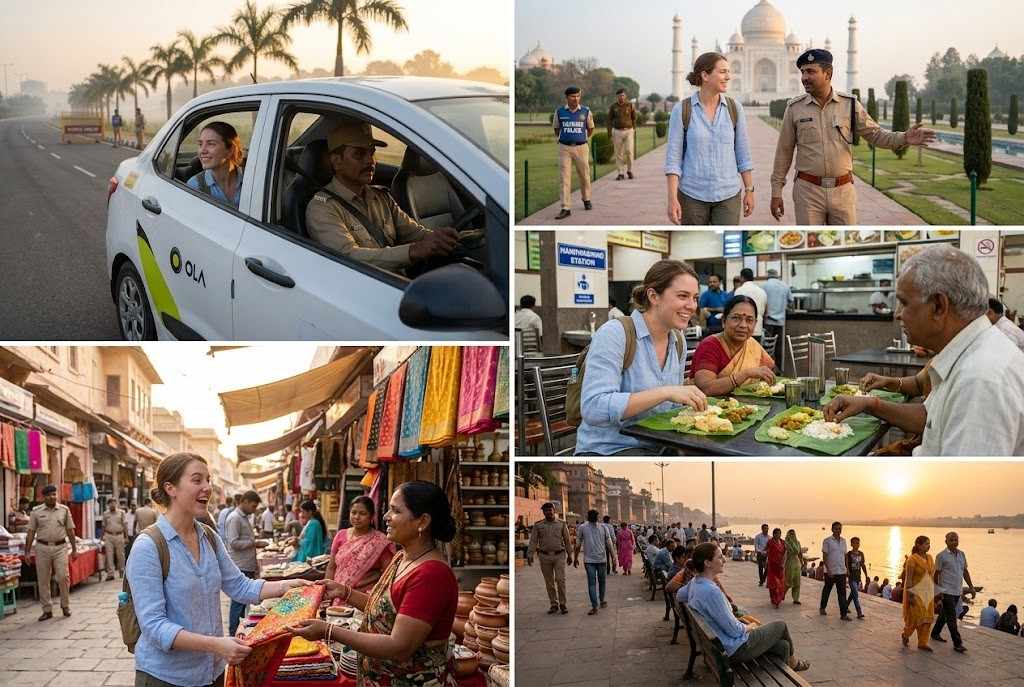
India is safe. That is the direct answer, and it is the right one. Every major tourist destination in India, from Delhi and Agra to Kerala, Goa, Rajasthan, and Varanasi, has a visible police and security presence at monuments, transport hubs, and popular tourist areas. Tourist police units operate specifically to assist international visitors at the highest-footfall sites across the country. Millions of international travellers visit India every year and leave with strong memories and a desire to return.
The more useful answer is that India is safe with preparation and realistic expectations about what the risks actually are. The risks that exist are overwhelmingly in the category of petty crime, scams, and transport, not violent crime. Serious incidents targeting foreign travellers are statistically rare across the major tourist circuits. The US State Department rates India at Level 2, which means to exercise increased caution; the same rating is applied to France, Germany, and the United Kingdom.
Real risks foreign travellers face in India
Understanding the actual risk profile of India as a tourist destination is more useful than either dismissing concerns or amplifying them.
Petty theft and pickpocketing
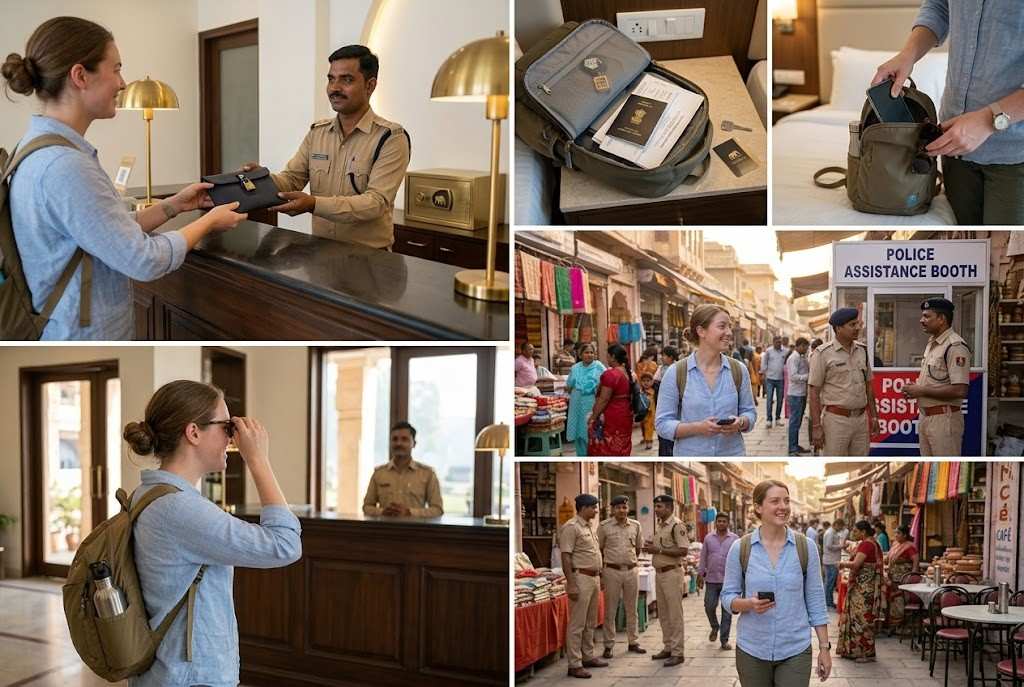
Pickpocketing and bag snatching are the most common crimes affecting foreign travellers in India. They peak at busy transport hubs, including New Delhi Railway Station, Mumbai’s Chhatrapati Shivaji Terminus, and crowded markets in major cities. Keep your passport in your hotel safe and carry a certified photocopy when sightseeing. Use a crossbody bag worn at the front in crowded areas. Keep your phone in a front pocket rather than a back pocket or open bag. Hotel room theft does occur. Use the in-room safe for valuables and do not open your door to unexpected visitors without calling reception to verify.
Tourist scams to know before you arrive
Scams targeting foreign travellers in India are common, well-documented, and almost entirely avoidable once you know what they look like. The most frequent involve fake booking websites mimicking legitimate hotels, a scam type that cyber crime authorities flagged as one of the fastest-growing tourist frauds in India in 2025. Gem and carpet scams near major monuments involve friendly locals who strike up conversation and eventually guide you to a shop where you are pressured into buying overpriced goods. Taxi drivers offering to take you to a better hotel or a government tourist office are almost always taking you to a commission-paying shop instead. Use Uber or Ola for all city transport (in Goa, use the GoaMiles app, as Uber and Ola are not available); book hotels only through verified platforms; and decline all unsolicited guidance from strangers near monuments.
Road safety and traffic
Road safety is a genuine concern in India. Traffic is dense, driving standards differ significantly from Western norms, and pedestrian crossings are often advisory rather than enforced. For long distances between cities, AC class train travel is significantly safer than overnight road journeys by private car. In cities, use Uber, Ola, or prepaid taxi counters at airports and stations (in Goa, use the GoaMiles app, as Uber and Ola are not available). Avoid renting motorbikes or self-driving in unfamiliar cities. If you do hire a private car with a driver for day trips, ensure the driver is vetted through your hotel or a licensed operator.
Which regions are safest for foreign travellers
India’s safety profile varies significantly by region. Where you go matters as much as how you travel.
Highly safe tourist circuits
The Golden Triangle connecting Delhi, Agra, and Jaipur is the most visited and most tourist-infrastructure-rich circuit in India. Dedicated tourist police operate at every major monument. Kerala, consistently rated among the safest states in India for travellers with one of the lowest violent crime rates in the country, is particularly well regarded for solo travellers. Goa has a long-established international tourist infrastructure and is considered very safe for foreign visitors. Rajasthan cities, including Udaipur, Jodhpur, and Jaisalmer, are safe and well-equipped for international tourism. Rishikesh and Varanasi receive large volumes of foreign travellers year-round with strong safety records in the main tourist areas.
Regions requiring extra caution
Northeastern states require an Inner Line Permit for foreign nationals in some areas. Rural and remote areas in any state require more preparation around medical access, transport reliability, and connectivity. Large city outskirts and non-tourist areas of major metros carry higher petty crime risk than the tourist circuits.
Deep forests, wildlife reserves, and remote areas

India has extraordinary national parks, tiger reserves, and forested regions, including Ranthambore, Corbett, Kaziranga, and the Western Ghats. These areas are safe and well-managed when visited through licensed operators and registered guides. Do not enter deep forest areas, wildlife reserves, or remote jungle trails without a registered local guide. This is both a safety requirement and a legal one in most protected areas. Going without a guide in these environments creates genuine risk from wildlife and terrain that is completely avoidable by using the official entry and guide systems every park provides.
Areas to avoid entirely
The Foreign and Commonwealth Development Office and the US State Department both maintain restrictions on travel within 10 km of the Pakistan border and to specific districts of Jammu and Kashmir, including Kupwara, Baramulla, and Punch. These advisories apply to border zones, not to popular tourist destinations. Srinagar and the main Kashmir Valley tourist areas are open and receive international visitors.
Transport safety for foreign travellers
Getting around cities safely
Uber and Ola operate in all major Indian cities and have transformed urban transport safety for travellers. Fixed upfront pricing means no fare negotiation, no overcharging, and a digital record of every journey. Always verify the vehicle plate number before getting in and share your ride details with someone you trust. For airport arrivals, use the prepaid taxi counter inside the terminal rather than accepting offers from drivers in the arrivals hall.
Long-distance travel tips
Indian Railways is one of the safest and most reliable ways to travel long distances in India. Book AC class tickets (1AC, 2AC, or 3AC) well in advance on IRCTC. Foreign travellers have access to a dedicated tourist quota on most major routes. Avoid overnight road journeys between cities where possible. Domestic flights are safe, punctual on major routes, and often competitively priced when booked two to four weeks ahead.
Financial safety: protecting your money in India
Financial risk is where most foreign travellers in India lose money without realising it is happening. The risks are specific and almost entirely preventable.
Common money scams targeting travellers
Shortchanging at markets and small shops is the most common financial scam targeting travellers. A vendor hands back change quickly and confidently, and the traveller assumes it is correct and moves on. Currency confusion between Rs 100 (approx. $1) and Rs 500 (approx $5.50) notes, which differ in colour but can be presented quickly, is a standard technique. ATM skimming devices have been reported at standalone ATMs in tourist areas. Use ATMs inside bank branches from SBI, HDFC, ICICI, or Axis rather than standalone machines on the streets.
Why digital payments reduce your risk
Every payment made via UPI creates an instant digital record showing the merchant name, amount, and timestamp. There is no cash to be shortchanged on, no notes to confuse, and no physical currency to be lost or stolen. A traveller who pays digitally for the majority of their spending carries less cash, creates a complete transaction record, and removes the most common friction points where financial scams occur. Find out how digital payments work for foreign travellers in India at CheqUPI.
How CheqUPI keeps your money safer
CheqUPI is an RBI-licensed prepaid payment instrument built by Terrafin Solutions Private Limited for foreign travellers and NRIs. You load it using your international credit or debit card. Loading costs 2.95% plus tax. Every merchant payment after that costs Rs 0. Because you load a fixed amount onto the wallet rather than carrying a card linked to your full bank balance, your financial exposure from theft or loss is limited to the wallet balance rather than your entire account. CheqUPI is free to join for all eligible nationalities. The loading fee is 2.95% + applicable taxes for all foreign users, and there is a cooling-off period (first 24 hrs) No Indian bank account or Indian SIM card needed. An internet connection and location access are required.
UPI is genuinely one of the most useful safety tools a foreign traveller can have in India. Pay for your auto-rickshaw, your market shopping, your restaurant meal, and your hotel top-up all from your phone, with a complete record of every transaction, and carry barely any cash at all. Less cash means less risk at every step of the trip.
Solo travel safety in India
Solo female travel
India is safe for solo female travellers on the established tourist circuits with standard precautions. Kerala, Goa, Rajasthan, and Rishikesh all have large solo female traveller communities and well-developed support infrastructure. Book accommodation in well-reviewed guesthouses with 24-hour reception. Use Uber and Ola (use GoaMiles in Goa) rather than hailing autos at night. Dress modestly near temples and in smaller towns. Trust your instincts in uncomfortable situations and move away without hesitation.
Solo male travel tips
Solo male travellers face a lower profile of personal safety risk but are frequently targeted by scams and commission touts near major monuments. The gem scam, the friendly local with a cousin’s shop, and the unsolicited tour guide are almost exclusively directed at solo male travellers. Polite but firm refusals and Uber for all transport reduce exposure significantly.
Health and practical safety tips
Drink bottled or filtered water only. Tap water is not safe to drink anywhere in India for travellers without prior acclimatisation. Eat at busy restaurants with high table turnover. Street food is generally safe at stalls with visible cooking and high footfall. Avoid pre-cooked food sitting uncovered.
Carry travel insurance that covers medical evacuation. Private hospitals in major cities are very good. Rural medical facilities vary significantly. Keep your original passport in your hotel safe and carry a certified photocopy when you go out. Submit the mandatory Air Suvidha e-Arrival Card online within 72 hours before your flight. As of 2026, this is required for all foreign travellers arriving in India.
Emergency numbers in India: Call 112 for any emergency (police, ambulance, or fire). This is India’s nationwide integrated emergency helpline. You can also use 108 for ambulance services in many states. Tourist Helpline: 1800-11-1363 (toll-free).
Conclusion
India is safe for foreign travellers who arrive prepared. Every major destination has police, security, and tourist support infrastructure in place. The risks that exist are specific, well-documented, and largely preventable with the right transport choices, payment setup, and basic situational awareness. Use Uber and Ola for city transport; book through verified platforms; set up a CheqUPI wallet before you fly so you carry less cash and every payment has a digital record; and use a registered guide for any deep forest or wildlife reserve visit. Millions of travellers visit India every year and leave wanting to come back. The preparation is worth it.
Frequently asked questions
1.Is India safe for solo female travellers in 2026?
Yes, on established tourist circuits, including Kerala, Goa, Rajasthan, and Rishikesh, with standard precautions. Use Uber or Ola at night, book vetted accommodation, and trust your instincts in uncomfortable situations.
2.What are the safest places to visit in India for foreign travellers?
Kerala, Goa, Rajasthan (Udaipur, Jaipur, Jodhpur), the Golden Triangle (Delhi, Agra, Jaipur), and Rishikesh are consistently rated the safest and most tourist-friendly destinations in India.
3.What are the most common scams targeting travellers in India?
Fake booking websites, gem and carpet scams near monuments, taxi commission scams, and shortchanging at markets. All are avoidable with Uber for transport, verified booking platforms, and digital payments.
4.Is it safe to use ATMs in India as a foreign traveller?
Use ATMs inside bank branches from SBI, HDFC, ICICI, or Axis rather than standalone street ATMs. Skimming devices have been reported at unmonitored standalone machines in tourist areas.
5.What travel precautions should foreign travellers take in India?
Keep your passport in the hotel safe, use ride-hailing apps for all city transport, book hotels through verified platforms, carry travel insurance, drink bottled water only, and use digital payments to minimise cash handling.
6.Is India safe at night for travellers?
In major tourist areas, yes, with standard precautions. Use Uber or Ola (use GoaMiles in Goa) rather than hailing autos after dark. Avoid walking alone in poorly lit or non-tourist areas at night in any city.
7.Is it safe to visit forests and wildlife reserves in India?
Yes, when visited through licensed operators and registered guides. Never enter deep forest areas, wildlife reserves, or jungle trails without a registered local guide. This is both a safety requirement and a legal requirement in most protected areas across India.
8.How do digital payments make India safer for travellers?
UPI payments eliminate cash handling, remove the shortchange risk, and create a digital record of every transaction. A UPI wallet like CheqUPI also limits financial exposure to the wallet balance rather than your full bank account, reducing risk from theft or loss.
9.What is the US State Department travel advisory for India in 2026?
Level 2: Exercise Increased Caution. The same rating applies to France, Germany, and the UK. Major tourist circuits are fully operational and safe with standard precautions.
10.How much cash should I carry in India as a foreign traveller?
Rs 5,000 to Rs 10,000 (approx $53 to $104) in small notes as a backup. Use a UPI wallet for the majority of daily spending to minimise how much cash you carry at any time.
“India is safe, and every major destination is ready for international visitors. The one practical step that makes the biggest difference on the ground is having your payments sorted before you land.
Download CheqUPI. Activate your wallet after arriving in India and start paying with UPI in minutes.”