Introduction
Shimla in summer is where North India comes to breathe. While the plains bake at 40 degrees and above, this hill town at 2,206 meters stays cool, green, and genuinely pleasant through May and June. The toy train, Mall Road, Jakhu Temple, and day trips to Kufri and Chail are all at their best during these months.
Weather by month, the best things to do, how to get there from Delhi and Chandigarh, what daily costs look like, and how to pay cashlessly as a foreign traveler without an Indian bank account. Shimla is easier to plan than most people expect, and getting the practical side sorted before you fly makes the whole trip run smoother.
What is UPI and why it matters in Shimla
UPI is India’s instant payment system, run by the National Payments Corporation of India (NPCI). It connects bank accounts directly. When a merchant shows you a QR code, the payment moves from one account to another in seconds with no card network involved.
Card machines are expensive, and most vendors in India, including Shimla’s mountain town traders, never installed them. They went straight to QR codes instead. Today you will find UPI QR codes at almost every shop, café, transport operator, and attraction in Shimla. A card terminal is rare outside of large hotels.
A foreign traveller on a tourist visa cannot open an Indian bank account, which means standard UPI apps like PhonePe and Google Pay are not an option. A prepaid UPI wallet solves this completely. You load it from your international card and pay any QR code in India exactly the way a local does. Find out how to set yours up before you fly at chequpi.com.
Key highlights
- Shimla sits at 2,206 meters above sea level and stays between 15 and 25 degrees Celsius during peak summer months of May and June, making it one of North India’s most popular hill stations.
- The Kalka-Shimla toy train is a UNESCO World Heritage railway that covers 96 km through 102 tunnels and 864 bridges in approximately 5 to 6 hours.
- Mall Road is Shimla’s main pedestrian promenade, lined with colonial-era buildings, shops, cafés, and one of the best Himalayan viewpoints in the region.
- Jakhu Temple, at 2,455 meters, is the highest point in Shimla and home to a large population of rhesus monkeys that are entertaining and occasionally unpredictable.
- Most shops, cafés, and transport operators in Shimla accept UPI QR payments. A prepaid wallet like CheqUPI lets foreign travelers pay without an Indian bank account.
- CheqUPI is free to join for all eligible nationalities. The wallet loading fee is 2.95% + applicable taxes for all foreign users. There are no transaction fees when paying merchants through UPI.
Shimla weather in summer
Summer is the most popular season to visit Shimla, and for good reason. While the plains of Punjab, Haryana, and Delhi reach temperatures of 40 to 45 degrees Celsius, Shimla stays consistently cool and pleasant through most of the summer months.
March to June
March to June is Shimla’s peak summer season, with pleasant weather and clear skies making it ideal for sightseeing and outdoor activities. Daytime temperatures typically range from 15°C to 28°C, while nights remain cool at around 10°C to 15°C. The weather is generally dry until the monsoon begins in late June or early July. This is also the busiest period for domestic tourists, especially during school holidays, so hotels and the toy train often book out well in advance. Reserve your accommodation and tickets at least three to four weeks ahead.
July to September
The monsoon season in Shimla runs from July to September, bringing frequent and sometimes heavy rainfall. Temperatures typically range from 15°C to 23°C, and the hills become lush and vibrant, making this one of the region’s most scenic and romantic times to visit. However, the season also carries the highest risk of landslides, road closures, travel delays, and poor visibility. Check weather and road conditions before traveling, allow extra time for journeys, and pack waterproof clothing. The toy train usually operates, but delays or temporary disruptions are possible during severe weather.
What to pack for Shimla in summer
Light layers work best. Days can be warm enough for a t-shirt in sunshine, but evenings drop quickly after sunset. A light jacket or fleece is essential for evenings and early mornings. Comfortable walking shoes are important because Mall Road and the surrounding areas involve a lot of uphill and downhill walking on uneven surfaces. Waterproof shoes or a second pair of shoes are worth carrying during July and August.
Top things to do in Shimla in summer
Mall Road and Scandal Point
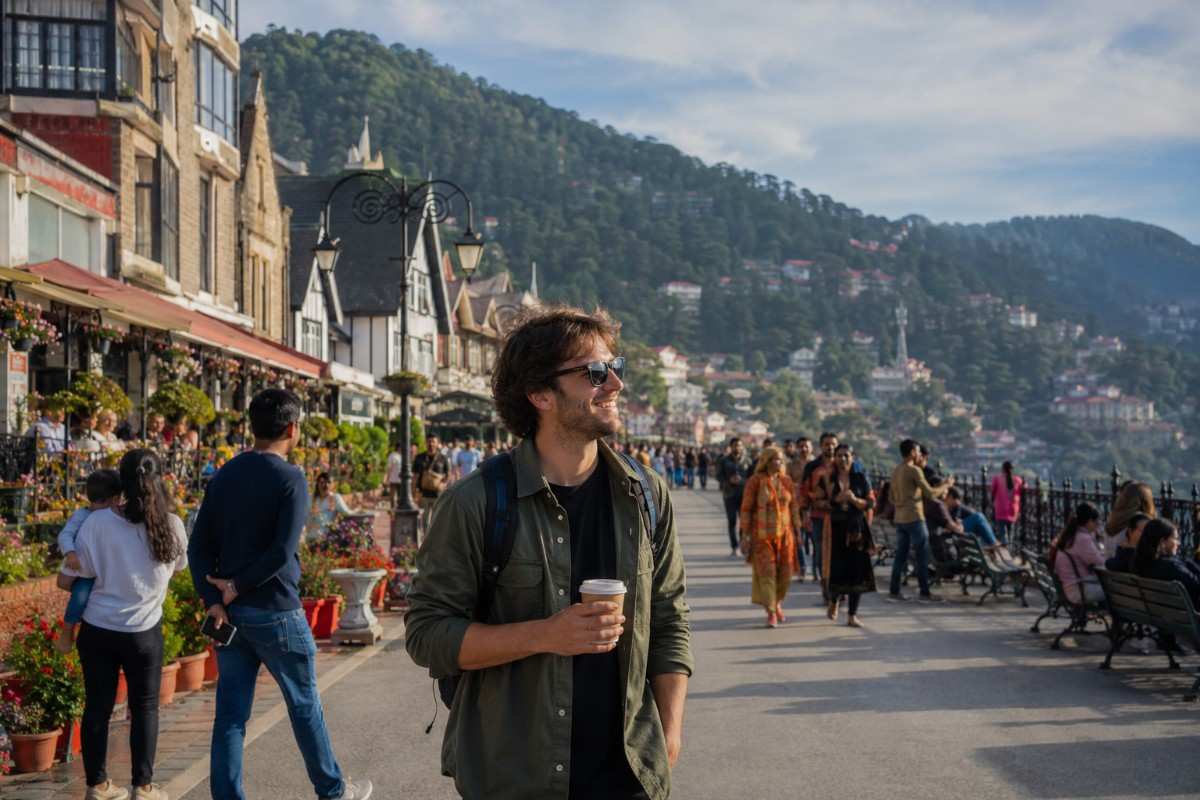
Mall Road is the heart of Shimla and the place most visitors spend the majority of their time. The road is pedestrian-only and runs along the ridge of the hill with views over the valley on one side and colonial-era buildings on the other. Scandal Point, at the western end of Mall Road, is where the road opens into a wide viewpoint. The name comes from a 19th-century story involving the Maharaja of Patiala and the viceroy’s daughter. The view is better than the story.
Most shops and cafés along Mall Road accept UPI QR codes. Entry to the road itself is free. A cup of chai at a café on the ridge costs Rs 30 to Rs 60 depending on the establishment. Momos from a street stall run Rs 50 to Rs 100 for a plate.
The Kalka-Shimla toy train
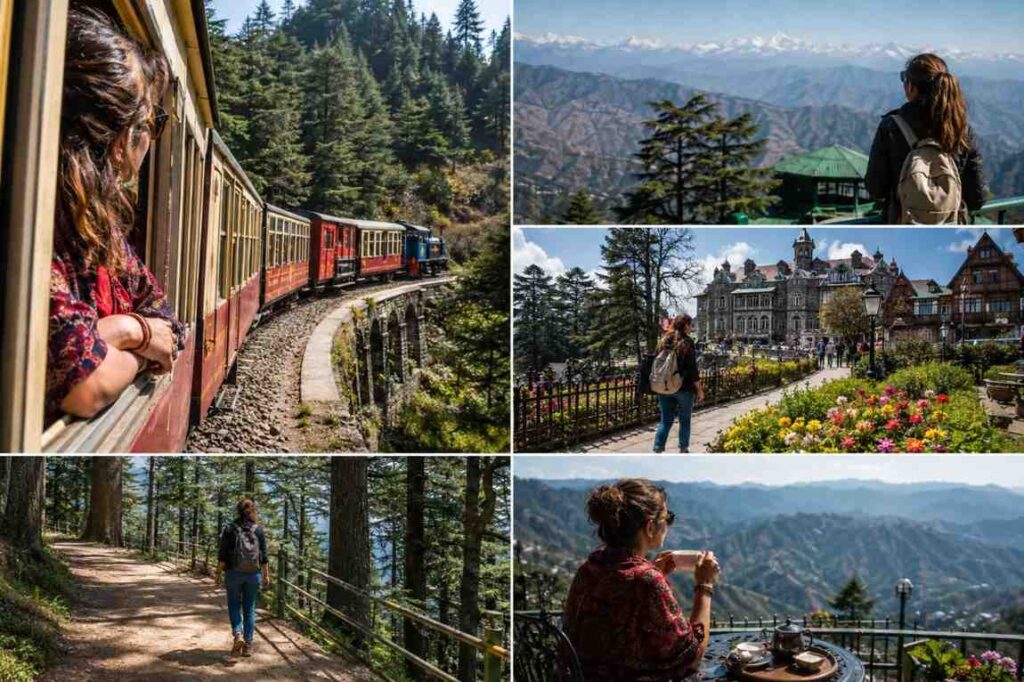
The Kalka-Shimla railway is one of the great train journeys in India and one of the few UNESCO World Heritage railways in the world. The line covers 96 km through 102 tunnels and 864 bridges, climbing from 656 meters at Kalka to 2,076 meters at Shimla in approximately 5 to 6 hours. The views through the windows, particularly in the middle section through the higher tunnels, are extraordinary.
Tickets should be booked in advance through IRCTC . The rail car class is the most comfortable option, and the Shivalik Deluxe Express is the most popular train on the route. Tickets range from Rs 65 to Rs 630 depending on the train and class. Prices vary, and booking early is essential during summer months. Book directly through IRCTC to avoid third-party markups.
Jakhu Temple
Jakhu Temple is dedicated to Lord Hanuman and sits at 2,455 meters, about 2 km from the center of Shimla. The walk takes approximately 30 to 45 minutes and passes through dense forest. The monkeys at Jakhu are famous and should be taken seriously. They are bold, fast, and attracted to food, bags, glasses, and anything shiny. Keep food in sealed bags, hold onto your belongings firmly, and do not make eye contact or try to feed them.
The temple itself is worth the climb for the views over Shimla and the surrounding hills. Entry is free. There is a ropeway to the temple for those who prefer not to walk, with tickets at approximately Rs 252 (approx $3) one-way or Rs 467 (approx $5) return per adult, plus 5% GST. Verify current pricing directly before visiting.
Christ Church and the Ridge
Christ Church, built in 1857, is one of the oldest churches in North India and one of the most photographed buildings in Shimla. It sits at the eastern end of the Ridge, a large open plaza above Mall Road. The combination of the church, the neo-Gothic architecture, and the Himalayan backdrop behind it is one of the most distinctive views in any Indian hill town. Entry is free.
Kufri day trip
Kufri is 16 km from Shimla by road, about 30 to 45 minutes by taxi. At approximately 2,622 meters, it is higher than Shimla and offers wider views over the surrounding hills. In summer, Kufri is popular for horse riding and short nature walks. The Himalayan Nature Park at Kufri is worth visiting for wildlife, including snow leopards and Himalayan birds. Entry fees apply: Rs 50 (approx $0.50) for Indian tourists and Rs 200 (approx $2) for foreign tourists per adult. A return taxi from Shimla to Kufri costs approximately Rs 800 to Rs 1,200. Prices vary by season and operator. Verify directly before booking.
Note: Once check latest pricing
Naldehra golf course
Naldehra is 23 km from Shimla and home to one of the oldest golf courses in India, established in 1905 by Lord Curzon. The course sits at 2,708 meters surrounded by cedar forests. Playing a round here is one of the more unusual things to do in Shimla and genuinely worth it for the setting alone even if golf is not your primary interest.
Note: Once check latest pricing
Best places to visit near Shimla in summer
Kufri
Already covered above as a day trip. The drive from Shimla to Kufri passes through apple orchards and dense pine forests and is worth doing even without a specific attraction at the end.
Chail
Chail is 45 km from Shimla by road, approximately 1.5 hours by taxi. It is quieter than Kufri and less visited by domestic tourists, which makes it a good option for foreign travellers who want to avoid crowds. The Chail Palace, built by the Maharaja of Patiala in 1891 after he was banished from Shimla by the British, is the main attraction and now operates as a heritage hotel. The Chail Cricket Ground, the highest cricket ground in the world at 2,444 meters, is also here. A return taxi from Shimla costs approximately Rs 1,500 to Rs 2,500. Prices vary by season and operator. Verify directly before booking.
Note: Once check latest pricing
Naldehra
Already covered above under activities. Combine it with Chail for a full day out from Shimla.
How to get to Shimla
From Delhi by toy train
The most atmospheric way to arrive in Shimla from Delhi is by overnight train to Kalka followed by the toy train to Shimla. The Delhi to Kalka train takes approximately 4 to 5 hours and costs Rs 300 to Rs 1,200 depending on class. The Kalka to Shimla toy train then takes approximately 5 to 6 hours. Total journey time from Delhi is approximately 10 to 12 hours. Book both legs through IRCTC well in advance during summer months.
From Chandigarh by road
Chandigarh is 120 km from Shimla by road, approximately 3 to 3.5 hours by taxi or bus. This is the most common route for travelers arriving by domestic flight. Chandigarh airport receives flights from Delhi, Mumbai, and other major cities. A taxi from Chandigarh to Shimla costs approximately Rs 1,800 to Rs 2,500. Prices vary by operator and season. Verify directly before booking. Buses from Chandigarh to Shimla run frequently and cost Rs 150 to Rs 300.
By flight to Shimla airport
Shimla has a small airport at Jubbarhatti, 23 km from the city center. Flights from Delhi operate on this route but are limited and subject to weather cancellations due to the mountain location. Check current schedules directly with airlines before planning. A taxi from the airport to Shimla costs approximately Rs 800 to Rs 1,200. Prices vary. Verify directly before booking.
Note: Once check latest pricing
How to pay in Shimla as a foreign traveller
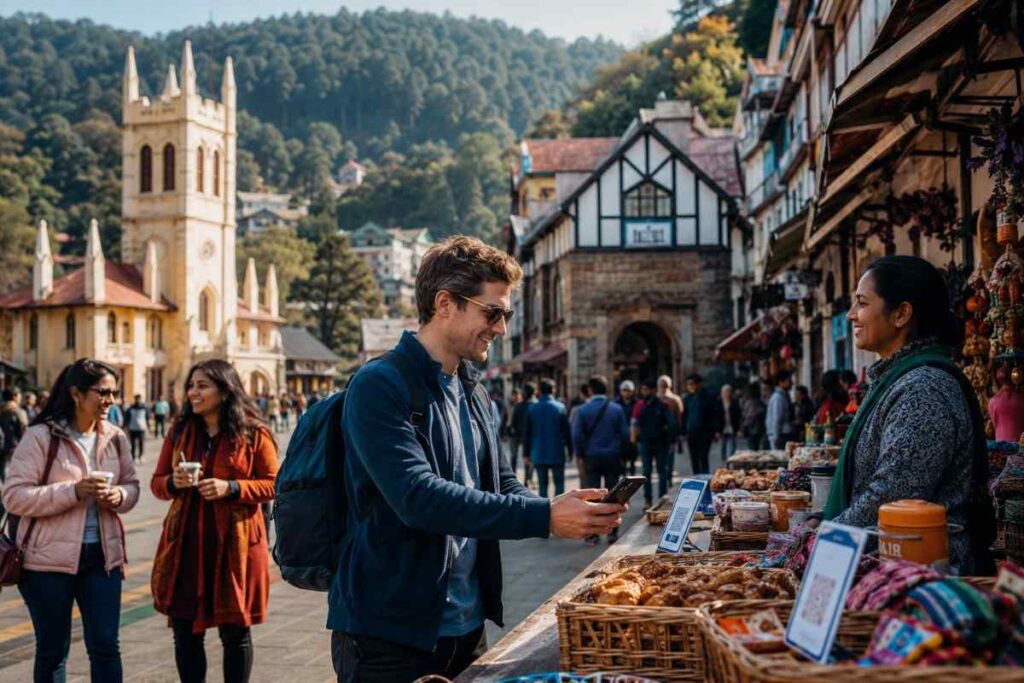
Almost every payment you make in Shimla will involve a UPI QR code. Mall Road shops, café counters, the souvenir market near Christ Church, auto-rickshaws, and local transport all use QR codes as their primary payment method. Your international Visa or Mastercard cannot reach those codes because UPI runs on a domestic bank-to-bank rail that international card networks have no connection to.
A foreign traveller on a tourist visa cannot open an Indian bank account, so standard UPI apps are not an option. CheqUPI is an RBI-licensed prepaid wallet built by Terrafin Solutions Private Limited for exactly this situation. It is backed by Y Combinator (W22) and operates under Transcorp International’s PPI and AD Cat-II license through the UPI One World network. You load it from your international card and pay any merchant QR code in Shimla exactly the way a local does.
CheqUPI is for paying registered merchants (P2M). P2P transfers are not supported under RBI regulations. No Indian bank account or Indian SIM card needed. An internet connection and location access are required. After arriving in India, a quick verification step activates your wallet in 5 to 10 minutes. CheqUPI has branches across India. Check chequpi.com for current locations before you travel.
Shimla daily budget for foreign travellers
Shimla is a mid-range destination for foreign travelers. Accommodation has a wide range, transport is affordable, and food is cheap at local restaurants and street stalls. The main costs are getting there and the toy train, both of which are worth the spend.
| Category | Budget | Mid-range | Splurge |
| Accommodation per night | Rs 800 to 1,500 (approx $8 to $16) | Rs 2,500 to 5,000 (approx $26 to $53) | Rs 8,000 and above ($85 and above) |
| Food per day, 3 meals | Rs 300 to 600 (approx $3 to $6) | Rs 800 to 1,500 (approx $8.50 to $16) | Rs 2,500 and above ($26 and above) |
| Local transport per day | Rs 200 to 500 (approx $2 to $5) | Rs 500 to 1,200 (approx $5 to $13) | Rs 2,000 and above ($21 and above) |
| Activities per day | Rs 100 to 300 (approx $1 to $3) | Rs 500 to 1,500 (approx $5 to $16) | Rs 3,000 and above ($32 and above) |
| Daily total | Rs 1,400 to 2,900 (approx $15 to $31) | Rs 4,300 to 9,200 (approx $46 to $98) | Rs 15,500 and above ($164 and above) |
Note: All figures are estimates for June 2026. Accommodation prices in Shimla rise sharply during peak summer weeks in May and June and during school holiday periods. Prices vary by season and operator. Verify directly before booking. USD conversions are approximate at Rs 94 to $1. Always check chequpi.com/pricing for the latest CheqUPI rates before you travel.
For a full breakdown of what your India trip is likely to cost, visit chequpi.com.
Travel tips for foreign travellers in Shimla
Walking in Shimla involves significant uphill and downhill gradients. Comfortable shoes with grip are more important here than at most Indian destinations. If you have knee issues, pace yourself and use the ropeway options where available.
The monkeys at Jakhu Temple are not a photo opportunity. They will approach you confidently. Keep all food sealed, hold your bag close to your body, do not wear sunglasses on top of your head, and do not try to feed them. Monkey bites do occur and require medical attention immediately.
Shimla gets cold quickly after sunset even in summer. Always carry a light jacket or fleece when heading out in the evening. The temperature drop from 3 PM to 7 PM can be significant, particularly in July and August.
Carry Rs 5,000 to Rs 10,000 in cash for very small vendors, temple donations, and situations where mobile signal is weak enough to affect QR code payments. Use your CheqUPI wallet for everything else. For broader travel safety across India, visit chequpi.com.
Book the toy train well in advance. During peak summer weeks in May and June, tickets sell out days to weeks ahead. Check availability on IRCTC as soon as you have your travel dates confirmed.
Conclusion
Shimla in summer is exactly what it promises to be: cool air, colonial character, mountain views, and one of the great short train journeys in Asia. The toy train, Mall Road, Jakhu Temple, and the day trips to Kufri and Chail cover enough ground for three to four days without any of it feeling rushed. Set up your CheqUPI wallet before you fly so that every shop on Mall Road and every café with a Himalayan view is one you can pay at without a second thought. The mountain is ready. The payments should be too.
Frequently asked questions
1.What is the weather like in Shimla in summer?
Summer in Shimla runs from March to June, with pleasant daytime temperatures of 15°C to 28°C and cooler evenings between 10°C and 15°C. The monsoon arrives in July and continues through September, bringing frequent rainfall and temperatures of 15°C to 23°C.
2.What is the best time to visit Shimla in summer?
May and early June are the best weeks, before the monsoon arrives in late June or early July. Weather is clear, temperatures are pleasant, and all attractions and transport operate at full capacity. Book accommodation and the toy train well in advance.
3.What are the top things to do in Shimla in summer?
Mall Road and Scandal Point, the Kalka-Shimla toy train, Jakhu Temple, Christ Church and the Ridge, a day trip to Kufri or Chail, and Naldehra golf course are the main highlights for summer visitors.
4.How do I book the Kalka-Shimla toy train?
Book through IRCTC at irctc.co.in. The Shivalik Deluxe Express is the most popular option. Book at least two to four weeks ahead during peak summer months. Tickets range from Rs 65 to Rs 630 depending on the train and class.
5.Are the monkeys at Jakhu Temple dangerous?
They are bold and unpredictable. Keep all food sealed and in a closed bag, hold your belongings firmly, remove sunglasses from your head, and never try to feed them. Monkey bites do occur and require immediate medical attention.
6.Can foreign travelers use UPI or digital payments in Shimla?
Yes, at most shops, cafés, and transport operators in Shimla. Your foreign card will not work at UPI QR codes. Use a prepaid wallet like CheqUPI and carry Rs 5,000 to Rs 10,000 in cash for very small vendors and weak-signal areas.
7.How much cash should I carry in Shimla?
Rs 5,000 to Rs 10,000 in small notes is enough as a backup for very small vendors, temple donations, and areas with weak mobile signals. Use a CheqUPI prepaid wallet for the majority of your spending across the town.
8.How do I get from Delhi to Shimla?
The most atmospheric option is an overnight train from Delhi to Kalka followed by the toy train to Shimla; the total journey is approximately 10 to 12 hours. A taxi from Chandigarh takes 3 to 3.5 hours by road and costs approximately Rs 1,800 to Rs 2,500.
9.How many days do I need in Shimla?
Three to four days covers Mall Road, Jakhu Temple, Christ Church, the toy train journey, and a day trip to Kufri or Chail. A fifth day allows for Naldehra or a slower pace on the second day in town.
10.What happens to my CheqUPI wallet when my India visa expires?
Any unused wallet balance can be refunded any time as per request to your international card upon account closure or visa expiry.
“Shimla in summer is one of the most rewarding short trips from any major Indian city. The mountain town, the colonial architecture, and the toy train are all waiting. Download CheqUPI. Activate your wallet after arriving in India and start paying with UPI in minutes.”