
India uses the Indian Rupee, runs on a mix of cash and QR-code payments depending entirely on where you are standing, and has a note that was withdrawn from circulation in 2023 that still confuses tourists who encounter one in change. Getting comfortable with INR before you land makes every transaction from your first taxi to your last bazaar purchase significantly easier.
INR denominations are clearly explained, how much cash to actually carry, where to exchange it at a fair rate, the currency scams worth knowing, and how to access India’s digital payment economy without an Indian bank account. It is all here.
Key highlights
- The Indian Rupee (INR, symbol ₹) is the only legal tender in India. No other currency is officially accepted for transactions.
- Current valid banknotes are Rs 10, Rs 20, Rs 50, Rs 100, Rs 200, and Rs 500. The Rs 2,000 note was withdrawn from circulation in 2023 and is no longer a valid tender.
- The approximate exchange rate in 2026 is Rs 94 per USD, Rs 125 per GBP, and Rs 108 per EUR. Rates fluctuate daily; check a live converter before exchanging.
- Foreign tourists can bring a maximum of Rs 25,000 (approx $265) in Indian Rupees into India. Foreign currency above $5,000 in cash must be declared on arrival.
- Airport currency exchange counters charge 8% to 9% above the mid-market rate. City ATMs from major banks are significantly cheaper.
- CheqUPI is an RBI-licensed UPI wallet that lets foreign tourists load funds via international card and pay at 55 million+ QR-code merchants without an Indian bank account.
What is the Indian rupee, and how does it work?
The Indian rupee is the official currency of India, issued and regulated by the Reserve Bank of India. The currency symbol is ₹, and the international code is INR. One rupee divides into 100 paise, though paise coins below Rs 1 are rarely used in daily transactions and have no practical relevance for tourists.
The word “rupee” derives from the Sanskrit word “rūpya,” meaning wrought silver. The modern rupee has been India’s official currency since independence in 1947, with the ₹ symbol officially adopted in 2010. Approximate exchange rates in 2026: Rs 94 per USD ($1), Rs 125 per GBP (£1), Rs 108 per EUR (€1). These rates fluctuate daily. Always check a live rate on Google or XE before any currency exchange transaction.
INR denominations: notes and coins explained
Knowing which notes are in your wallet and which are no longer valid saves real confusion at payment counters.
Banknotes in circulation
The following banknotes are currently valid legal tender in India: Rs 10, Rs 20, Rs 50, Rs 100, Rs 200, and Rs 500. Each note differs in size, color, and design to aid identification. The Rs 500 note is the most commonly used denomination for mid-sized purchases and ATM withdrawals. The Rs 100 note is the most useful for small daily transactions.
Coins in circulation
Valid coins include Rs 1, Rs 2, Rs 5, Rs 10, and Rs 20. The Rs 10 coin is the most common. Rs 20 coins are a relatively recent addition and look similar to Rs 10 coins; check the number clearly before accepting change. Coins below Rs 1 are no longer in circulation and have no transaction value.
The Rs 2,000 note: what tourists need to know
The Rs 2,000 note was withdrawn from circulation by the RBI in May 2023 and is no longer a valid legal tender. If you receive one in change, which happens occasionally with uninformed or dishonest vendors, do not accept it. Some tourists are handed old Rs 2,000 notes or demonetized Rs 1,000 notes (withdrawn in 2016) disguised in a bundle of valid currency. Always count your change and check each note before walking away from any exchange counter or vendor. Also inspect your banknotes. Some vendors may refuse older series notes, as well as soiled, torn, or damaged currency.
How much cash should you carry in India?
The honest answer is less than most tourists think, but in smaller denominations than most tourists bring.
Daily cash needs by spending type
Rs 3,000 to Rs 5,000 (approx $32 to $53) in physical rupees is a practical backup reserve for most tourists on any given day. This covers auto-rickshaw fares, temple donation boxes, street food, small ferry tickets, and vendors without QR codes.
Why small notes matter more than large ones
The change problem in India is real and persistent. A vendor selling Rs 30 chai cannot break a Rs 500 note (approx $5.50). A rickshaw charging Rs 80 (approx $1) will struggle to change Rs 200 (approx $2). Carry your cash in Rs 10, Rs 20, Rs 50, and Rs 100 denominations for daily street-level spending. Keep Rs 500 notes for larger purchases at shops and restaurants. ATMs typically dispense Rs 500 notes, so break them at supermarkets, hotel receptions, or pharmacies as early in the day as possible.
Where to exchange currency in India
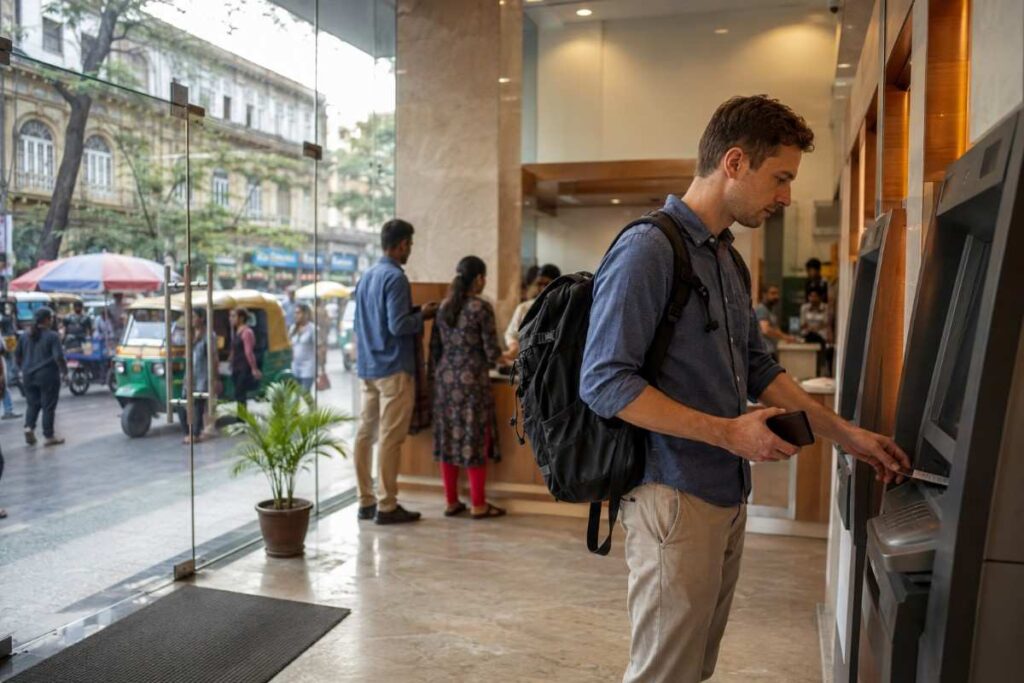
Where you exchange determines how much you lose before spending a single rupee on something you actually want.
RBI-authorised money changers in city centres
Licensed money changers in commercial areas of Delhi, Mumbai, Bengaluru, Kochi, and Jaipur typically offer rates 1% to 3% above the interbank rate. This is significantly better than airport or hotel counters. Verify any money changer’s RBI license at the RBI website before transacting. Never exchange with unlicensed street operators regardless of the rate offered. For broader guidance on keeping your money safe in India, see our safety guide for tourists.
Bank ATMs: the most practical option
ATMs from SBI, HDFC, ICICI, and Axis Bank give you the Visa or Mastercard network rate, typically 1% to 2% above the interbank rate. Your home bank adds a fixed withdrawal fee of Rs 200 to Rs 335 (approx $2 to $3.5) and a foreign transaction fee of 1% to 3%. Withdraw larger amounts per visit to minimize the fixed fee impact per rupee received. Always select INR when the ATM offers a choice of currencies. Choosing your home currency activates Dynamic Currency Conversion, which adds an extra markup that goes directly to the ATM operator.
What to avoid: airport counters and hotel desks
Airport currency exchange counters in India charge 8% to 9% above the mid-market rate. Hotel desks typically charge 3% to 5%. Both are convenient and significantly more expensive than the alternatives. Exchange only the minimum at the airport (Rs 2,000 to Rs 3,000/approx. $20 to $30) for immediate taxi and SIM card needs, and get the rest from a city ATM or authorized money changer.
Currency rules and limits for foreign tourists
How much foreign currency can you bring into India
Foreign tourists can bring any amount of foreign currency into India. However, if you carry more than $5,000 in cash or more than $10,000 in total cash and travelers checks combined, you must declare it on a Currency Declaration Form (CDF) at customs on arrival. Failure to declare above the threshold can result in confiscation.
INR import and export limits
Foreign tourists are generally not permitted to bring Indian Rupees (INR) into or out of India. Instead, they should carry foreign currency and exchange it for INR after arriving in India through authorized banks, money changers, or ATMs. If you have leftover Indian Rupees before departure, exchange them back into your home currency at an RBI-authorized money changer or bank before leaving the country.
What to do with leftover rupees
Reconvert leftover rupees to your home currency at an RBI-authorized money changer or bank before departure. Keep your original exchange receipt as proof of transaction, as it may be required for reconversion. Major international airports in Delhi, Mumbai, and Bengaluru have reconversion counters after security.
Foreign tourists are not permitted to bring Indian Rupees into or out of India. Any leftover INR should be exchanged before you leave the country.
Currency scams to know before you arrive
The note-switching scam
A vendor or money changer hands you change quickly and confidently. Mixed in the bundle are demonetized Rs 1,000 notes, damaged notes that small shops will not accept, or lower-denomination notes presented to look like higher ones. Always count your change note by note before putting it away. Check for the denomination number clearly on each note.
Fake ATMs and skimming devices
Card skimming devices have been reported at standalone ATMs in tourist areas. Use ATMs inside bank branches during banking hours wherever possible. Shield your PIN when entering it. If an ATM card slot looks unusual or has any loose attachments around it, use a different machine.
The closed exchange booth redirects
A person approaches you near a money changer and tells you it is closed, under inspection, or offering a bad rate today, and offers to take you to a better option. The better option is always either unlicensed or running a scam. Verify hours directly with the exchange counter and ignore all unsolicited guidance near money-changing areas.
How to access UPI without cash or an Indian bank account

Why does UPI matter for tourists handling currency?
India has 55 million+ UPI-enabled merchants. Most street food vendors, local restaurants, auto-rickshaws in cities, pharmacies, market stalls, and museum ticket counters accept QR-code payments, and many no longer maintain card terminals or keep change for large notes. A tourist who only has cash faces the change problem on every small transaction. A tourist who has UPI access does not.
How does CheqUPI give foreign tourists UPI access?
CheqUPI is an RBI-licensed prepaid payment instrument built specifically for foreign tourists and NRIs. You load it using your international credit or debit card at a fee of 2.95% + applicable taxes for all foreign users, plus tax per top-up. Every merchant payment after that costs zero. No Indian bank account is required. Once loaded, you scan any merchant QR code in India and pay instantly. CheqUPI is free to join for all eligible nationalities. The loading fee is 2.95% + applicable taxes for all foreign users. For a complete guide on setting up and using a UPI wallet in India, see our complete UPI guide.
Tipping in India: amounts and etiquette
Tipping is not mandatory in India but is genuinely appreciated. Always tip in Indian rupees rather than foreign currency, which small vendors cannot easily exchange.
| Service | Suggested tip |
| Restaurant (no service charge) | 10% of the bill |
| Hotel bellboy | Rs 50 to Rs 100 (approx $1) per bag |
| Housekeeping | Rs 50 to Rs 100 (approx $1) per day |
| Private driver (full day) | Rs 200 to Rs 300 (approx $2 to $3) |
| Tour guide | Rs 300 to Rs 500 (approx $3 to $5) |
| Auto-rickshaw | Rounding up to the nearest Rs 10 is appreciated |
Check your restaurant bill for a service charge before tipping. If a 10% service charge is already included, an additional tip is optional. Digital tipping via UPI QR code is becoming more common at mid-range restaurants and tour operators in major cities.
Conclusion
The Indian rupee is straightforward once you know which notes are valid, which denominations matter most at street level, and where to exchange it without losing 10% before you spend a rupee. Keep Rs 5,000 to Rs 10,000 (approx $53 to $106) in small notes as a daily backup, use a city ATM rather than an airport counter, check every note you receive change, and set up a UPI wallet to cover the majority of merchant spending digitally. India’s payment system rewards tourists who arrive prepared.
FAQs
1.What is the currency in India for tourists?
The Indian Rupee (INR, symbol ₹) is the only legal tender in India. No other currency is officially accepted for transactions. Current valid notes are Rs 10, Rs 20, Rs 50, Rs 100, Rs 200, and Rs 500.
2.What INR denominations should tourists know about?
Valid banknotes are Rs 10, Rs 20, Rs 50, Rs 100, Rs 200, and Rs 500. The Rs 2,000 note was withdrawn in 2023, and the Rs 1,000 note was demonetized in 2016. Neither is a valid tender. Carry Rs 10 to Rs 100 notes for daily spending.
3.How much cash should I carry in India as a tourist?
Rs 5,000 to Rs 10,000 ($53 to $106) in small denominations as a daily backup reserve. Most tourist spending in major cities is now covered by UPI QR payments, which reduces how much cash you need to carry.
4.What are the best currency exchange tips for India?
Use city ATMs from SBI, HDFC, ICICI, or Axis Bank. Exchange only a small amount at the airport. Use RBI-authorized money changers in city commercial areas. Always choose INR at ATMs and never accept dynamic currency conversion.
5.Is the Rs 2,000 note still valid in India?
No. The Rs 2,000 note was withdrawn from circulation by the RBI in May 2023 and is no longer a valid legal tender. Do not accept it in change.
6.Can I bring Indian rupees into India as a foreign tourist?
No. Foreign tourists are generally not permitted to bring Indian Rupees into or out of India. Carry foreign currency instead and exchange it for INR after arriving through authorized banks, money changers, or ATMs.
7.Is USD accepted in India?
No. USD is not officially accepted for transactions in India. You must exchange it for INR before spending. Some hotels may accept USD informally but at very poor rates.
8.What do I do with leftover rupees when leaving India?
Reconvert at an RBI-authorized money changer or bank before departure. Keep your original exchange receipt. Airport reconversion counters are available airside at major Indian international airports.
9.Foreign tourists are not permitted to bring Indian Rupees into or out of India. Any leftover INR should be exchanged before you leave the country.
10.How do foreign tourists use UPI in India without an Indian bank account?
Through an RBI-licensed UPI wallet like CheqUPI. Load it using your international card. receive a UPI ID, and pay at any QR-code merchant in India by scanning. No Indian bank account required.
11.What currency scams should tourists watch out for in India?
Note switching (receiving demonetized or damaged notes in change), ATM skimming devices at standalone machines, and the closed exchange booth redirect scam where someone steers you toward an unlicensed operator. Count every note in change and use bank-branch ATMs only.
“Most tourists spend their first day in India breaking Rs 500 notes and looking for ATMs. Download CheqUPI. Activate your wallet after arriving in India and start paying with UPI in minutes.”