Every Mysore guide opens the same way: visit the palace, climb Chamundi Hill, and photograph Brindavan Gardens. Those are fine stops. But they are the stops where you stand in a queue, pay Rs 1,000 (approx $11) per foreign traveler just to enter the palace, and leave thinking you have seen Mysore. You have not.
The real character of this city sits in a 13th-century temple 35 km south, a spice market where vendors weigh turmeric on brass scales, a dosa at a tiny hotel that has not changed its recipe since 1938, and a lake where you can walk for an hour without seeing another tourist. Here is where to find it all, what to eat, and how to pay when your foreign card hits a wall.
Key highlights
- Mysore Palace charges Rs 1,000 (approx $11) per foreign traveler since November 2024. Every spot in this guide costs a fraction of that or nothing.
- Somnathpur Temple, 35 km from Mysore, holds some of the finest 13th-century Hoysala carvings in India. Entry is Rs 250 (approx $3) for foreign nationals.
- The Folklore Museum inside Jayalakshmi Vilas Mansion houses over 6,500 artifacts covering Karnataka’s folk traditions. Entry is free.
- Kukkarahalli Lake has a 4.5 km walking trail with no entry fee and regular sightings of pelicans, painted storks, and kingfishers.
- The original Mylari on Nazarbad Road has served the same butter dosa since 1938. The menu has four items.
- The Karnataka Silk Industries Corporation factory offers free guided tours where you watch raw silk become Mysore silk sarees.
- Most vendors at these spots accept only UPI QR codes or cash. A foreign card will not work at any of them.
The places the palace crowd misses
Somnathpur Temple, 35 km south
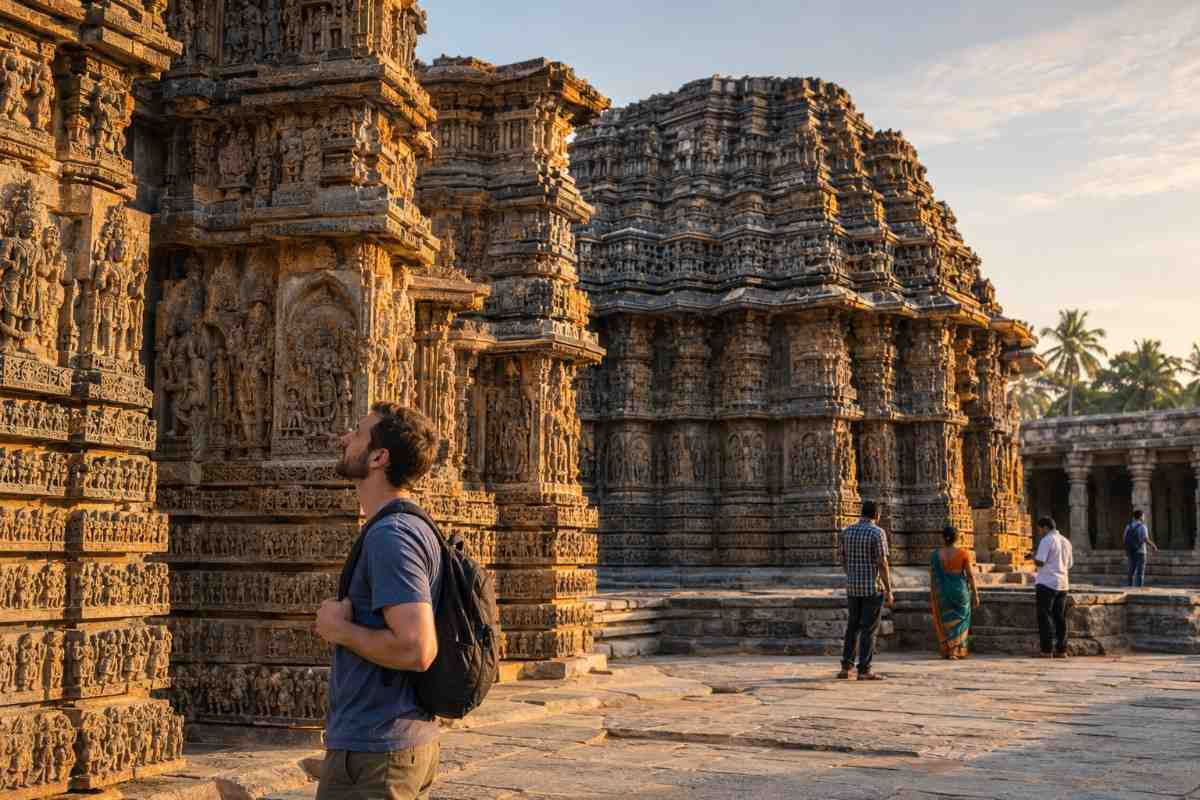
The Chennakeshava Temple at Somnathpur is a 13th-century Hoysala masterpiece, consecrated in 1258 CE. It sits about 35 km southeast of Mysore, and that distance keeps the crowds away. The star-shaped platform holds three shrines, each covered in carved panels depicting scenes from Hindu epics.
The detail here rivals anything at the Mysore Palace, but without the noise. On most weekday mornings, you might share the courtyard with five or six other visitors. Entry for foreign nationals is Rs 250 (approx $3) for cashless payment or Rs 300 (approx $3.20) if paying by cash. Compare that to the Rs 1,000 (approx $11) the palace now charges. The temple is maintained by the Archaeological Survey of India and stays open from 8:30 AM to 5:30 PM daily.
Plan about 90 minutes at the temple and 45 minutes each way by car. An auto from Mysore will quote around Rs 1,200 to Rs 1,500 (approx $13 to $16) for the round trip including wait time. Uber and Ola may not cover this route reliably. Agree on the fare before you start.
Jayalakshmi Vilas Mansion and the Folklore Museum
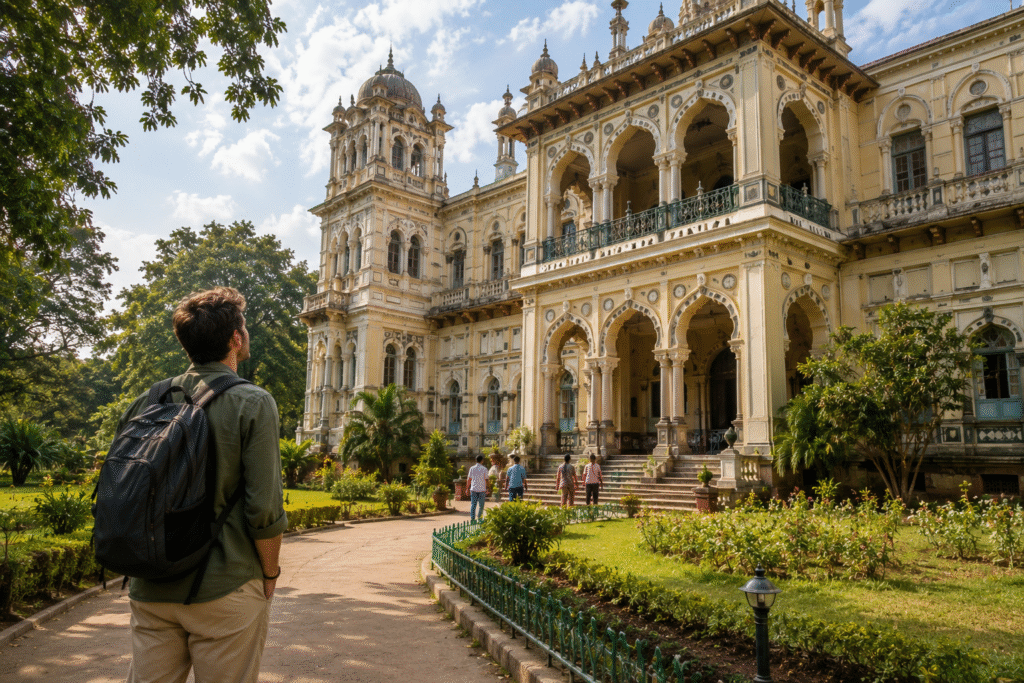
Inside the University of Mysore campus sits Jayalakshmi Vilas Mansion, a 1905 palace built by Maharaja Chamaraja Wodeyar. It now houses the Folklore Museum, which holds over 6,500 artifacts: Yakshagana costumes, leather shadow puppets, folk masks from across Karnataka, traditional musical instruments, and a 300-year-old temple cart from Shimoga.
Entry is free. No separate foreign traveller pricing. Open 10 AM to 5:30 PM, Monday to Saturday. Closed on Sundays, second Saturdays, and government holidays. Photography is not allowed inside. Most foreign travelers have no idea this place exists. The building itself is worth the visit even before you step inside, with its Indo-Saracenic arches and quiet garden setting.
Kukkarahalli Lake
A 4.5 km walking trail loops around this lake, about 3 km from the city center. There is no entry fee for anyone. Early mornings bring pelicans, painted storks, cormorants, and kingfishers. The University of Mysore borders one side, so the path is well maintained and safe to walk alone.
This is the kind of spot where Mysore residents jog before work. It is not on any tour itinerary. Bring a water bottle and a phone for bird photos. The full loop takes about an hour at a relaxed pace.
The Silk Factory tour
The Karnataka Silk Industries Corporation (KSIC) factory on Mananthody Road offers free guided tours on weekdays. No entry fee and no separate foreign traveler charge. You walk through the production floor and watch raw silk threads being spun, dyed, and woven into Mysore silk sarees on mechanical looms.
The factory outlet sells silk at government-fixed prices, which makes it cheaper than most shops in the city. Open Monday to Saturday, 7:30 AM to 4:30 PM. Closed Sundays. No booking required. Show up at the gate and ask for the tour.
The food you will not find in a hotel restaurant
The original Mylari and the four-item menu
The original Mylari on Nazarbad Main Road has served the same butter dosa since 1938, when the founder Gowramma named it after Lord Mylari, an incarnation of Shiva. The current owner, Sachin MC, is the fourth generation to run the kitchen.
The menu has four items: dosa, idli, coffee, and kashi halwa. That is it. The dosa is thicker than the standard crispy variety, folded in half, finished with a generous smear of butter, and served with white coconut chutney. A plate costs roughly Rs 60 to Rs 80 (approx $0.65 to $0.85), though prices may have changed since early 2026.
Several restaurants in Mysore use the Mylari name. The original is on Nazarbad Main Road. Look for “Old Original Vinayaka Mylari Hotel” to avoid the copies. Arrive before 8 AM or expect a short wait. Mylari does not accept foreign cards. Cash or UPI only. If you are wondering why international cards fail at Indian QR codes, a UPI wallet is the only bridge.
Devaraja Market and Guru Sweets
Devaraja Market on Sayyaji Rao Road has operated for over a century. No entry fee. The ground floor is a maze of spice stalls, flower vendors selling jasmine by the meter, and fruit sellers stacking pyramids of mangoes. The colors and smells alone are worth the walk.
Near the market, Guru Sweets on Sayyaji Rao Road sells the original Mysore Pak, a dense sweet made from gram flour, ghee, and sugar. A box of fresh Mysore Pak costs Rs 300 to Rs 500 (approx $3 to $5) depending on weight. Mysore Pak was created in the royal kitchens of the Mysore Palace, and Guru Sweets is one of the most trusted places to buy it fresh.
Churmuri, filter coffee, and the Rs 20 street stall
Churmuri is Mysore’s version of bhel puri: puffed rice, chopped onion, tomato, coriander, and a spicy chutney mixed in a paper cone. Vendors sell it outside Kukkarahalli Lake and near the palace gates for Rs 20 to Rs 30 (approx $0.21 to $0.32).
A tumbler of filter coffee at any local stall runs Rs 15 to Rs 25 (approx $0.16 to $0.27). These are the prices that make Mysore one of the cheapest cities to eat well in India. If you are weighing all your payment options, the guide on cash, card, or QR payments in India puts food costs in the context of a full trip budget.
But nearly every stall at this price range takes only cash or UPI. Your Visa or Mastercard is invisible here.
How to actually pay at these places
Where your foreign card works and where it does not
Hotels, a few upscale restaurants, and the KSIC outlet at the Silk Factory will likely accept a foreign card. That covers maybe 10% of the places in this guide. The other 90%, the original Mylari, Devaraja Market, churmuri stalls, auto drivers, and temple entry counters, run on UPI QR codes or cash.
Mysore is not a card-swipe city. Even large restaurants sometimes prefer UPI because the settlement is faster. A foreign credit or debit card cannot scan a UPI QR code directly. You need a wallet in between. Compared to losing 8% to 9% at airport money changers in India, a wallet loading fee of 2.95% is a fraction of the cost.
Why a UPI wallet covers the gap
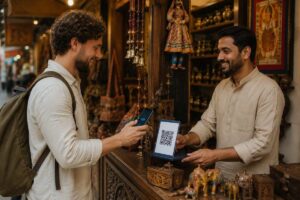
CheqUPI is free to join and works with any international Visa or Mastercard. You load rupees onto the wallet at 2.95% plus tax, and every merchant payment by QR after that costs 0%. It works at any of India’s 55 million-plus UPI merchants, including every stall, restaurant, and shop in Mysore that displays a QR code.
You do not need an Indian bank account or an Indian SIM card. An internet connection and location access are required. OTP sent via SMS and WhatsApp. If the SIM is not active, WhatsApp still works. After you download the app, a quick verification step takes 5 to 10 minutes once you arrive in India. CheqUPI has branches across India and is continuously expanding its network. For the full setup walkthrough, the guide on how to set up UPI as a foreign tourist covers every step.
If you are weighing a UPI wallet against a prepaid travel card, the forex card vs UPI wallet for India comparison breaks down the real costs side by side.
Getting around and staying safe
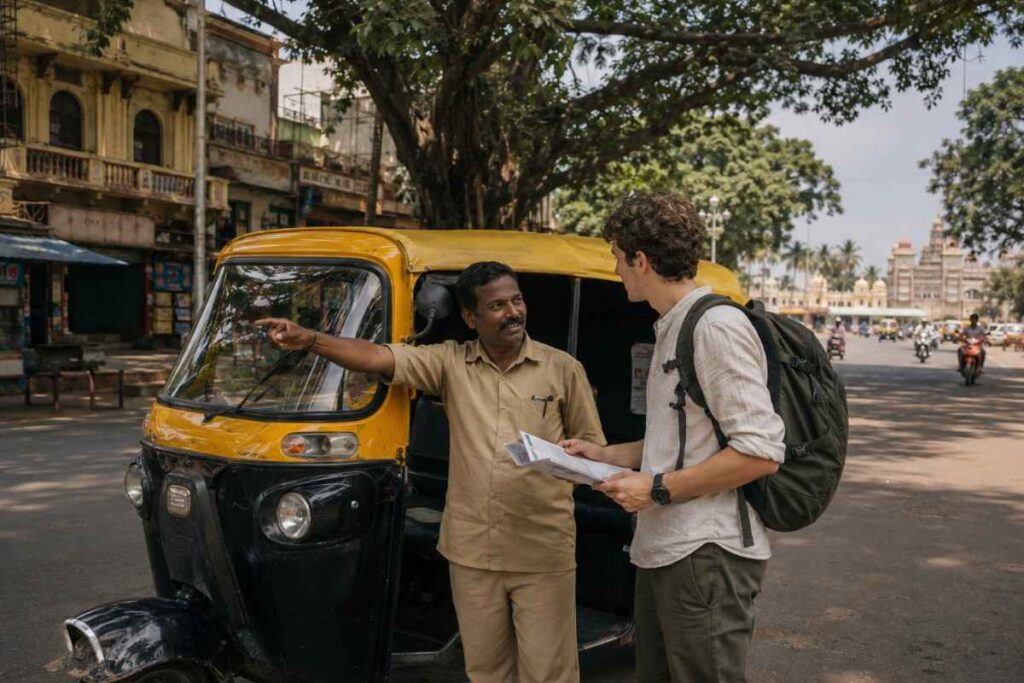
Mysore is compact enough to walk between the palace, Devaraja Market, and the original Mylari in about 20 minutes. For longer trips like Somnathpur, book an auto or hire a car for the day.
Uber and Ola work inside the city but are less reliable for the outskirts. Auto drivers will quote a price before the ride. The standard city fare runs Rs 50 to Rs 150 (approx $0.53 to $1.60) depending on distance. Agree on the amount before you sit down. Most auto drivers use personal UPI accounts, which means only cash works here since foreign national wallets support P2M transactions only.
The best months to visit Mysore are October to February, when the heat stays manageable. October is the standout month because of the Dussehra festival, when the Mysore Palace is illuminated with nearly 97,000 light bulbs. Mysore is safe for solo travelers. Stick to well-lit areas after dark and keep your phone charged for maps.
Conclusion
Mysore’s real personality lives in a 13th-century temple with almost no visitors, a four-item dosa menu that has not changed since 1938, and a spice market older than most countries. The palace is worth seeing once. These places are worth coming back for.
Download CheqUPI before you land and do activation once reached India; carry Rs 5,000 to Rs 10,000 (approx $52 to $105) in cash for auto rides; and spend the rest of your time eating, walking, and paying by QR at every stall between Kukkarahalli Lake and Devaraja Market.
FAQs
1. What are the hidden places to visit in Mysore?
Somnathpur Temple (35 km south), the Folklore Museum inside Jayalakshmi Vilas Mansion, Kukkarahalli Lake, and the KSIC Silk Factory are all off the standard tourist circuit and worth the detour.
2. Is Mysore safe for foreign travelers?
Yes. Mysore is one of India’s safest mid-sized cities. It is walkable, well-lit in central areas, and locals are accustomed to foreign visitors year-round.
3. What is the best local food in Mysore?
The butter dosa at the original Mylari on Nazarbad Road, fresh Mysore Pak at Guru Sweets on Sayyaji Rao Road, churmuri from street vendors, and filter coffee at any local stall.
4. Where is the original Mysore Pak from?
Mysore Pak was created in the royal kitchens of the Mysore Palace. Guru Sweets on Sayyaji Rao Road near Devaraja Market is one of the most trusted places to buy it fresh today.
5. Can foreign travelers use UPI in Mysore?
Yes. Foreign travelers from 180-plus FATF-compliant countries can use a prepaid payment instrument wallet like CheqUPI to pay by QR code at any UPI merchant. See the full guide on whether foreign tourists can use UPI in India.
6. How much does a dosa cost at Mylari Hotel?
At the original Mylari on Nazarbad Road, a plate costs roughly Rs 60 to Rs 80 (approx $0.65 to $0.85). Prices may have changed since early 2026. Hotel restaurant versions cost five to ten times more.
7. Is Somnathpur Temple worth visiting from Mysore?
Yes. The 35 km drive takes about 45 minutes. The 13th-century Hoysala carvings are among the finest in south India, and you will likely have the courtyard nearly to yourself.
8. Do Mysore street vendors accept foreign cards?
Almost never. Street food stalls, market vendors, and small restaurants in Mysore accept only UPI QR payments or cash. A UPI wallet like CheqUPI connects your foreign card to all of them.
9. What is the best time to visit Mysore?
October to February offers the most comfortable weather. October stands out because of the The Dussehra festival, when the Mysore Palace is illuminated and the city holds a grand procession.
10. How much does Mysore Palace charge foreign travelers?
Rs 1,000 (approx $11) per person since November 2024. Indian nationals pay Rs 120 (approx $1.28). Every hidden spot in this guide costs a fraction of that or nothing at all.
“CheqUPI lets you pay at every spot in this guide, from the Rs 20 (approx $0.21) churmuri stall to the Silk Factory outlet, without fumbling for change.”